


Every single morning, reasonably smart investors open their terminals and commit the exact same analytical sin: they demand a 100% win rate from their own skulls.
You spend days digging into ALAB 0.00%↑ or NVTS 0.00%↑ The earnings report is a blowout, the guidance is raised, and the structural tailwinds are as clear as day. But the second you open the order ticket, your brain breaks. You start obsessing over the perfect fill. You panic about buying the local top, or you start hallucinating a macro pullback that hasn’t even shown up on the tape.

The stock leaves you behind, prints another green candle, and you’re left sitting there, completely empty-handed, nursing a weird mix of FOMO and self-loathing. And here I’m talking about myself, not just asking for a friend. I hate this perfectionism setup, i hate losses, but that’s the part of the game. if you don’t lose you don’t win.
Let’s be honest here: this isn’t about a lack of research, and it’s definitely not a fear of losing money. If you’ve been in this game long enough, you know how to cut a bad position and move on. This is purely about the ego. Your brain is freezing your fingers on the execution because it would rather you miss the entire rally than face the uncomfortable truth of making an imperfect entry and feeling like an idiot for 48 hours.
We treat every single trade like a definitive IQ test. If the stock rips immediately after we buy, we’re market gods. If it drops 3% the next day, we’re exit-liquidity clowns who bought the highs again.
But the market isn’t an exam room, and you aren’t a prophet. Demanding absolute precision in a regime where multiples are warped and momentum rules the world is a mathematical delusion. It ruins your execution and bleeds your portfolio through missed opportunities.
Imagine running a joint
Here is the hard reality: imperfect entries and stop-outs are not a reflection of your intellect. They are just the operating cost of running the business. No different than a restaurant throwing away spoiled inventory at the end of the week.
As Peter Lynch famously put it:
“In this business, if you’re good, you’re right six times out of ten. You’re never going to be right nine times out of ten.”
The absolute best macro funds and structural managers on the Street—with all their PhD analysts and specialized data feeds—are incredibly happy with that 60% hit rate. In aggressive, news-driven momentum cycles, they are often wrong more than half the time.
They don’t make millions by predicting every single tick perfectly. They make millions because they manage the math. As George Soros bluntly observed:
“It’s not whether you’re right or wrong that’s important, but how much money you make when you’re right and how much you lose when you’re wrong.”
When top-tier players are wrong, they exit without a single emotion and lose a dollar. When they are right, they sit on their hands, let the trend run, and make five.
If you want to cure your analysis paralysis, you need to officially give yourself the right to be wrong about the short-term price action. Your only job is to spot a structural edge, calculate the size, and hit the button. What the market does with the price over the next two days is pure noise.

Once you accept that any single trade is just an isolated data point in a sequence of thousands, you stop overthinking the entry. You stop trying to time the absolute bottom. Instead, you build mechanical guardrails that let you make messy, imperfect entries while keeping your capital completely safe.
To give you an idea of how to strip the emotion out of the execution, here is the exact quantitative setup I use when I want to participate in a high-velocity or unfamiliar trend without letting my brain overcomplicate the trigger:
Case Study
Macro-Risk (Entry): Allocate an amount of capital you are completely at peace with losing. Whether it’s $500 or $5,000, it should be a sum that won’t change your lifestyle or make you sweat if it goes to zero. If you don’t know the deep, multi-year fundamentals, you hard-limit your overall exposure right at the door based on your own pain tolerance.
Micro-Risk (Price): Set a strict 20% stop-loss from your purchase price. This completely locks your maximum total loss on this specific idea to just one-fifth of that “disposable” amount.

Position Scaling (The Anti-Perfectionist Rule): Forget the old rule about “never buying higher.” In a savage momentum monster like ARM 0.00%↑ , waiting for a perfect pullback that never comes is just another form of paralysis. You are allowed to scale up and buy more as the price goes up, but only into strength. If the position is already in the green and the tape confirms you are right, you can add another tranche. Your only rule: move your stop-loss up to protect the new, higher average price. You build the position like a pyramid.
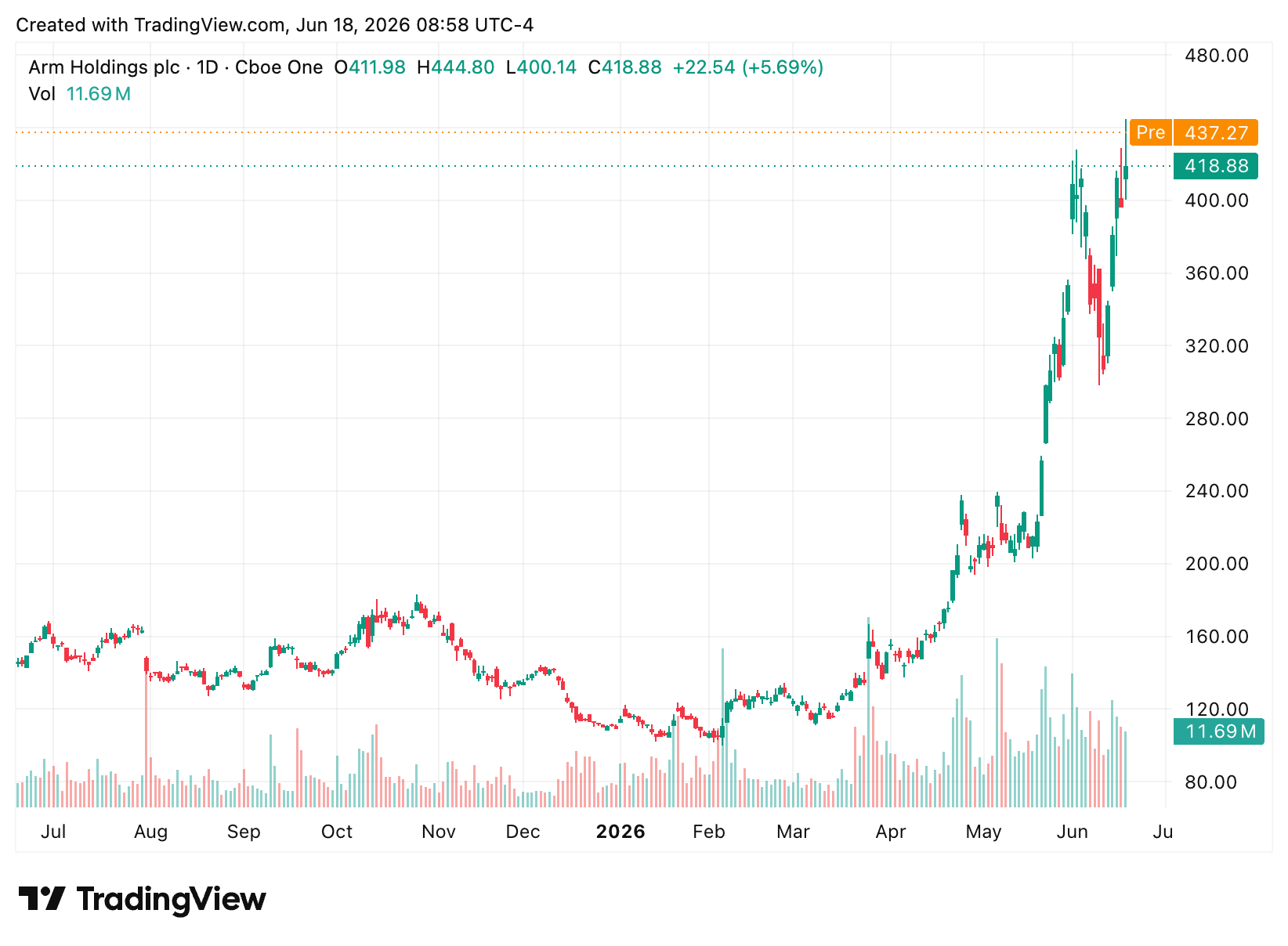
By converting your emotional bias into a cold, quantitative rule, you completely bypass the need to pick the “perfect” winner. If you lack the sector depth to pick a single stock, you apply this risk model to a mini-ETF of 3–4 players in that space, balancing potential runners against the duds.
The Black Box
There is one final catch to this system. The moment you hit the “Buy” button, your brain instantly starts trying to rewrite history. If the trade works, you’ll trick yourself into thinking you knew it all along. If it fails, you’ll blame the market gods.
To stop this psychological self-sabotage, you need a Black Box protocol.
The absolute second a trade goes live, you open your journal and document it. Not an hour later. Not at the end of the day. Right now. You write down exactly three things:
The Trigger: What was the specific fundamental or news catalyst that made you buy?
The Size: Exactly how much “disposable” capital did you put on the table?
The Plan: Where is your hard stop, and where do you intend to scale up or take profit?
Write a cold, clinical log. This journal isn’t a diary for your feelings; it’s a mirror that keeps you honest. When you have your exact thesis written down in black and white while your heart is still pumping, you leave your ego zero room to lie to you later. It turns trading from an emotional rollercoaster into a repeatable, auditable process.
Just Hit the Button
Let another quote from Soros hang over your desk the next time you feel your finger freeze over the mouse:
“I’m only rich because I know when I’m wrong... My financial success stands in sharp contrast with my ability to forecast outcomes. I am as capable of making mistakes as the next person. But where I do excel is in recognizing my mistakes.”
When you take away the ridiculous self-imposed pressure of needing to be perfectly right, the paralysis completely vanishes.
If the fundamental thesis is solid and the catalyst is real, open the position with a tiny, non-event tranche. Log it immediately, set your automated bracket orders, hard-cap your risk, and close the terminal. If the market reverses and hits your stop, you didn’t fail a test. You just paid a minor transaction fee to test a live thesis.
Stop playing a fictional game where every single move has to be flawless. Accept the market’s messiness, automate your downside, log your actions, and give yourself permission to execute imperfectly. It’s the only way to actually make money.
This publication is for educational and informational purposes only and does not constitute financial, investment, or trading advice. Readers are solely responsible for their own investment decisions. The author doesn’t hold a position in the securities mentioned.