

ORCL 0.00%↑ showed that the company is successfully transforming into an infrastructure giant. Total quarterly revenues increased 21% to $19.2 billion vs $19.10 billion expected. Cloud revenues (IaaS + SaaS) increased 47% to $9.9 billion driven by 93% growth in Cloud Infrastructure (IaaS), and 10% growth in Cloud Applications (SaaS). Software revenues were down 2% to $6.8 billion, reflecting customers’ continuing migration from on-premise software to the Cloud.
Earnings per share came in at $2.03 adjusted vs. $1.96 expected and, most importantly, the company confirmed its revenue guidance for the upcoming year at $90B. By 2030, the company wants to reach $225B, setting highly ambitious goals.
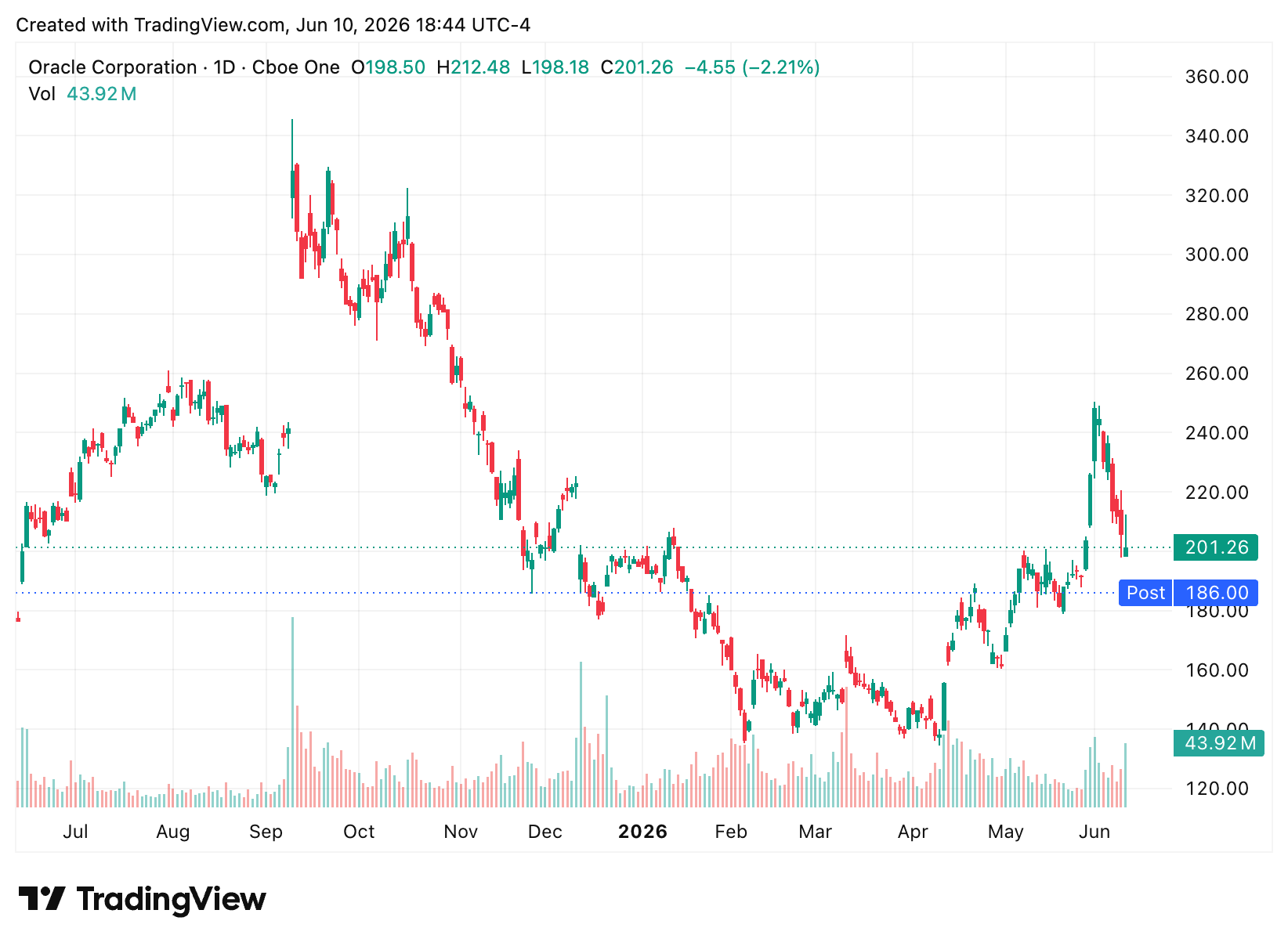
A vital metric for this is Remaining Performance Obligations, or RPO, which ended the quarter at $638 billion, up 363% USD year-over-year and up $85 billion sequentially from the end of Q3. This indicates massive demand for data centers that shows zero signs of slowing down; in any other market, the stock wouldn’t be dropping 7%, it would have already taken off. Just bad timing. At the same time, investors have grown more cautious about infrastructure plays due to high debt levels.

Just the day before, Crusoe reported that a client asked to pause data center construction, though sources say it was actually due to resistance from local residents, and another company is rumored to be taking over the project. In short, the sentiment ahead of the print was highly anxious. Meanwhile, Oracle plans to bring 1GW online in Q1’27 alone, compared to 1.2GW delivered across the entire fiscal year 2026.
All GPUs are taken
On the call, CEO Clay Magouyrk dropped a key note, stating that the Global GPU utilization rate is sitting at 97.5%, even though only about half of the 59 clients renewed their contracts for 35,000 GPUs. Those who stay are taking capacity to the absolute maximum, meaning the data centers face zero idle time. Moreover, roughly $20-25B comes from client prepayments, so Oracle itself will only need to borrow $40B externally, $20B of which is the already announced ATM equity issuance, while total Capex hits $70B. Contracts where clients either bring their own GPUs or pay upfront have reached $75B.

On top of that, the market has started cutting borrowing rates for infrastructure companies; just recently, Applied Digital secured financing at 7% instead of the 10% demanded a few months ago. As another growth vector, Oracle highlighted the MultiCloud database segment, which surged 404% in Q4. Oracle Health is also projected to post double-digit growth in the upcoming fiscal year, signaling that the $28B Cerner acquisition is finally starting to pay off. Oracle is also teaming up with OpenAI to make frontier models and Codex directly available to OCI clients.
However, the stock still tumbled 10% because the market is fundamentally unready for good news. High inflation, a looming war in Iran with zero signs of diplomatic progress - are negotiations even happening? - have poisoned the tape. It is easy to imagine how much more volatile the reaction would have been if there had been any actual mentions of construction delays.
The price to pay
Ultimately, this aggressive pivot means the company is paying a substantial price to secure its future. Pushing Capex to $55.6B has compressed Free Cash Flow to negative $23.7B for the fiscal year, requiring continuous external capital raises and a temporary pause in meaningful share buybacks alongside the upcoming $20B ATM dilution.
Furthermore, while Oracle successfully defended a strong 45% non-GAAP operating margin this quarter, management openly noted that operating margins will head lower next year as the revenue mix shifts from legacy software to heavy hardware infrastructure.
Yet, with a 97.5% GPU utilization rate keeping the current footprint highly efficient, this massive capital investment is a necessary and calculated move
Death of the Software Subscription
Oracle is fundamentally reshaping enterprise software monetization by abandoning traditional seat-based licensing in favor of two distinct models.
The first is outcome-based pricing. Instead of charging a fixed monthly fee per user regardless of utility, Oracle now ties its revenue directly to measurable business outcomes delivered by its autonomous agents. In healthcare, billing is tied to patient throughput.
In HR, fees are based on the number of candidates screened and moved to final stages. In sales, hospitality and retail assistants take a percentage cut of closed upsell transactions. This lowers the barrier to adoption, as corporate clients only incur costs when the software generates verifiable operational savings or revenue.
The second model is universal token bundles, which provide enterprise buyers with strict budget predictability. Instead of buying separate software modules, clients purchase a predictable pool of tokens and allocate them dynamically across application suites, shifting capacity to HR agents during a hiring surge or to ERP agents during end-of-quarter financial closing.
Right now, looking at Oracle’s standard 10% Cloud Applications (SaaS) growth completely misses the revolution. These new token bundles are still in a limited rollout phase with only 33 major corporate clients, including Aon and Liberty Energy, participating in Q4. Because clients buy these tokens in advance, the billions in cash prepayments do not show up in current revenue, instead, they sit locked in an unprecedented $85 billion quarterly surge in RPO.
This creates a massive cash spring. As these initial 33 clients - and the thousands waiting in line - gradually burn through their tokens to run live AI agents over the coming quarters, the current 10% growth rate is mechanically set to accelerate significantly over time.
While SaaS used to monetize through flat-rate add-on fees, Oracle is shifting toward utility billing and performance-sharing, securing highly predictable, high-margin revenue pipelines
Buying Opportunity
Another positive sign for investors is that the company won a major government contract for HR optimization. My valuation of the company remains unchanged—I believe it should be worth at least $250. All of my calculations can be viewed here:

The earnings report proves once again that there is massive demand for compute, and GPUs remain highly sought after by clients who actually know how to monetize them. In other words, differentiation is taking place in the market, which is a highly positive factor.
I also see a clear positive in the fact that the company is operating in an environment of fierce competition against the Hyperscalers despite having significantly smaller financial resources, yet it continues to grow at 20% a year even with a stagnating SaaS segment.
Another major advantage for the company is its ability to offer a full stack of services simultaneously; they possess a complete cloud infrastructure, and the more GPU clients they acquire, the greater their monetization opportunities become.
Oracle also promises higher earnings from its healthcare business, an industry where, as we know, serious money changes hands. All in all, today’s sell-off can be used as an opportunity to add to the position. Given the new bombings of Iran, the price could drop further, so the macro landscape must be taken into account.
This publication is for educational and informational purposes only and does not constitute financial, investment, or trading advice. Readers are solely responsible for their own investment decisions. The author is long Oracle.
The GPU utilization numbers are certainly impressive. The question I’m still wrestling with is whether infrastructure demand and shareholder returns scale together. A business can win the AI buildout and still disappoint investors if expectations or capital intensity outrun economics. That’s the distinction I’m watching most closely.