


Power module maker Vicor’s earnings came as no surprise, as the company had already raised its guidance twice following patent dispute wins. I see massive upside ahead provided they can execute on their manufacturing schedule.
Now, onto the numbers:
Q3 Financials (Double Beat):
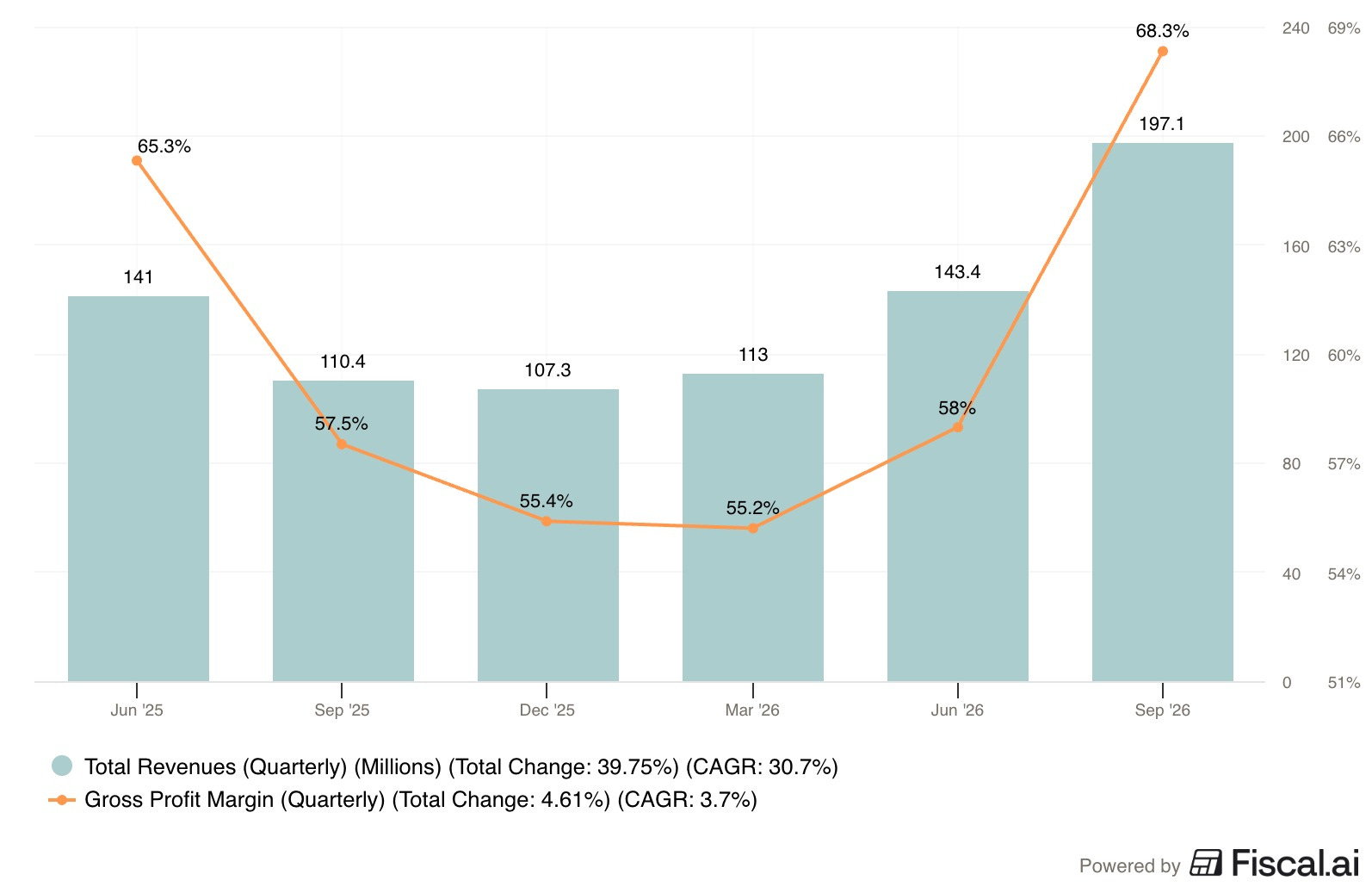
• Revenue: $197.1M (+37.5% QoQ, +78.5% YoY) vs. $172M consensus.
• Gross Margin: 68.3% up from 58% in Q2.
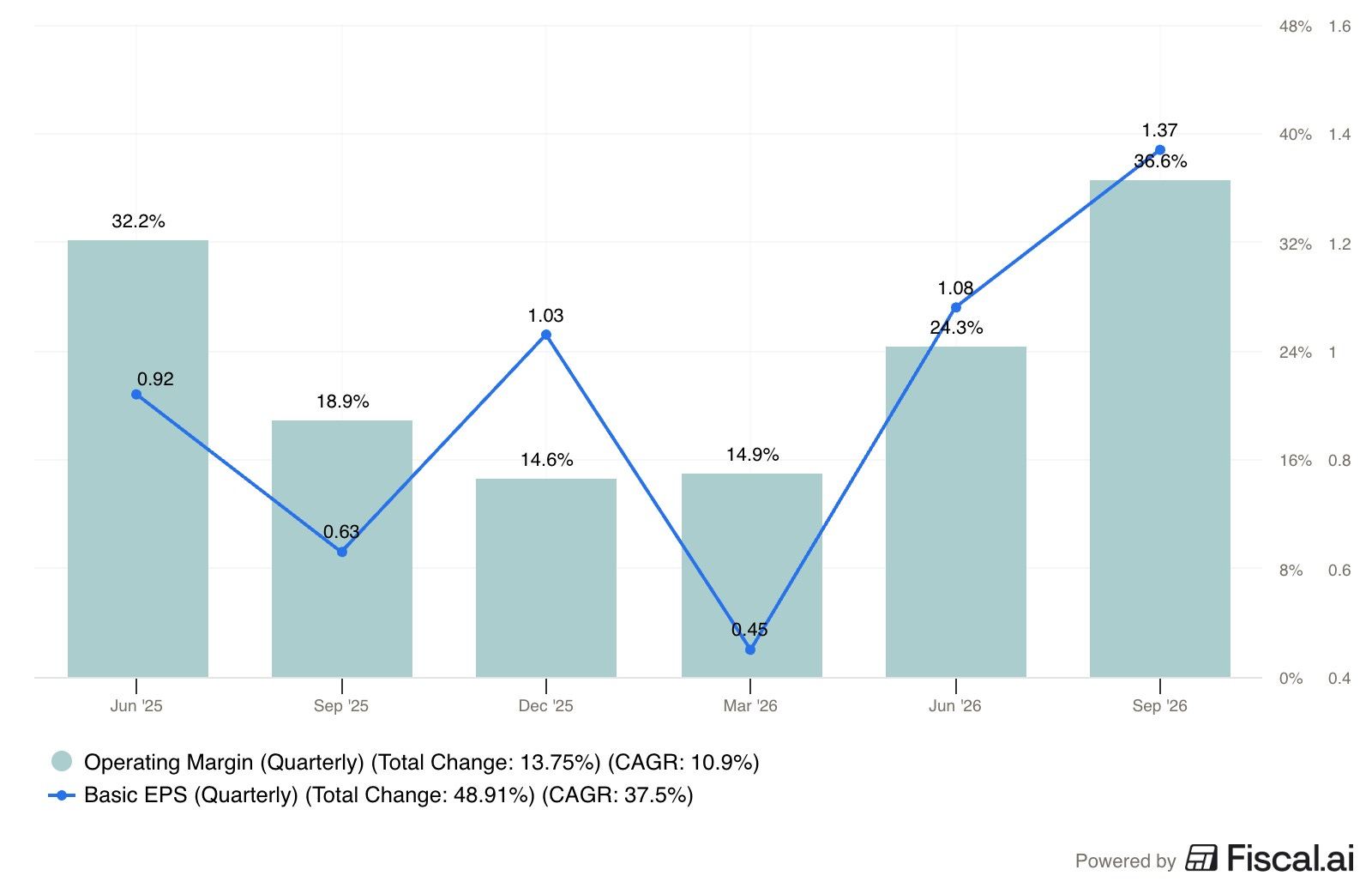
• Net Income: $63.3M, GAAP diluted EPS of $1.33 vs. $1.18 est.
• Royalty revenue: skyrocketed +119% QoQ to $66.6M.
The key driver behind the gross margin surging toward 70% was the spike in licensing and royalty revenue, which jumped 119% QoQ to $66.6M. Because these revenues carry virtually zero cost of goods sold, every royalty dollar flows straight to the bottom line.
Vicor’s top line rests on two pillars: in-house manufacturing and technology licensing. The company commits substantial capital to litigation, with Taiwanese giant Foxconn becoming its latest target.

Legal Leverage: Royalty Escalation and the Threat of an ITC Ban
Management urged investors to stop viewing royalties as non-recurring one-offs. The baseline guidance for Q4 is set at a conservative $43M, even without signing any new agreements.
The first license for Vertical Power Delivery (VPD) technology has already been inked with a leading AI server OEM, while two additional hyperscalers have requested comprehensive licensing terms.
Vicor has established an aggressive tiered licensing structure:
Stage 0: Voluntary licensing prior to litigation at the lowest base rate.
Stage 1–3: If an infringer refuses to settle, Vicor initiates an investigation with the U.S. International Trade Commission (ITC). From that point on, the royalty rate escalates by ~5% for every month the proceedings are dragged out.
Final Stage: A Limited Exclusion Order enforced by U.S. Customs, completely blocking imports of unlicensed AI servers into the United States.
For server ODMs (including disputes with players of Foxconn’s scale) and hyperscalers, halting shipments of systems worth hundreds of billions of dollars is simply not an option. Settling and licensing remains the only pragmatic path forward.
Manufacturing Capacity: 5x Expansion with Zero Debt
Driven by surging demand, the backlog climbed to $406M (+7% QoQ), with an additional $100M in new bookings captured in just the first two weeks of Q4.
To eliminate manufacturing bottlenecks, the company closed acquisitions on two sites:
Fab-2 (Merrimack): An existing 330,000 sq. ft. industrial facility. Tool move-in begins in Q2 2027 to relieve specific processes constraining throughput at Fab-1.
Fab-3: Land acquired for long-term greenfield construction.
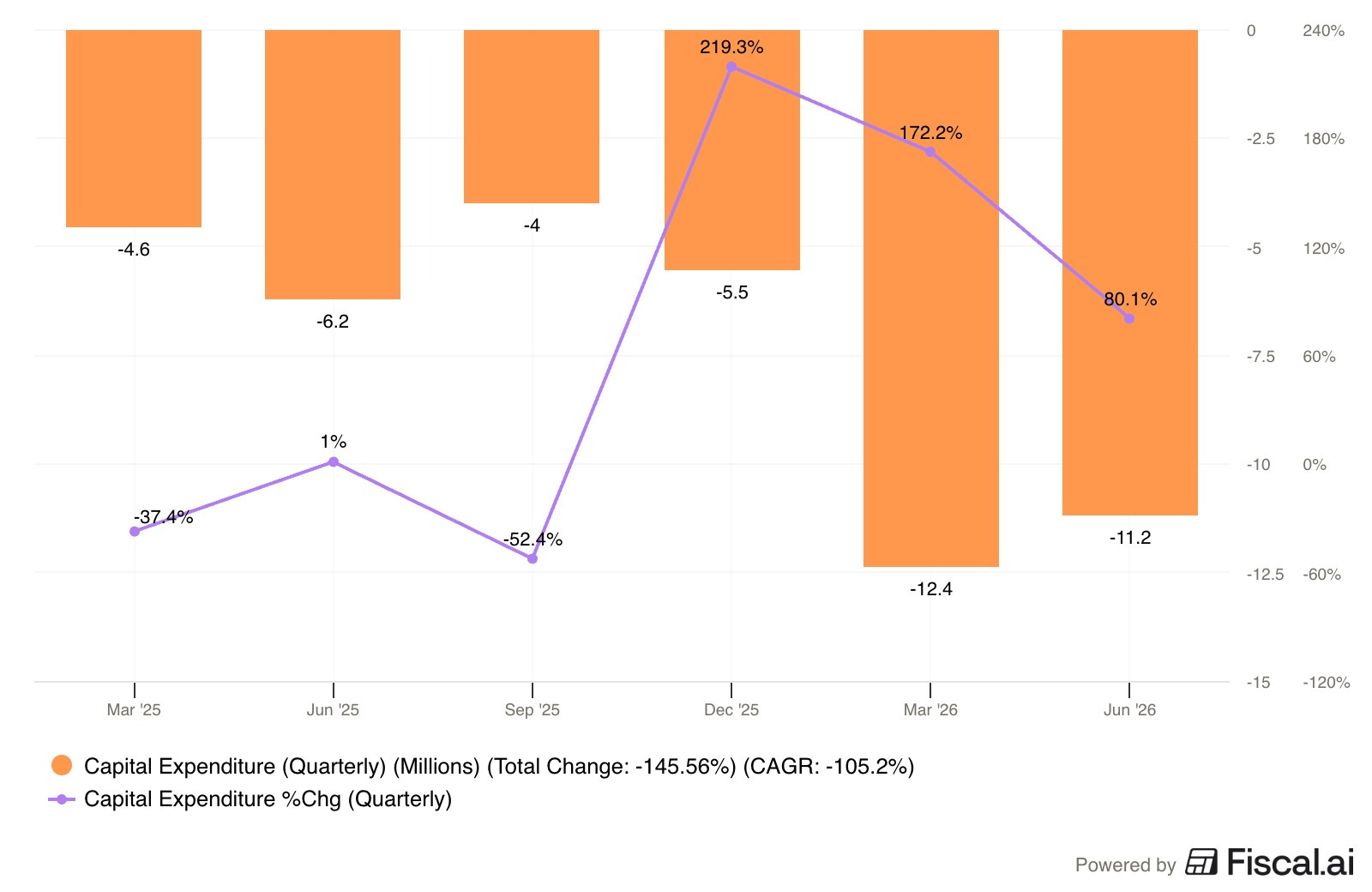
Together, these sites provide the real estate to scale output capacity more than 5x. The entire CapEx buildout is funded via operating cash flow and a $513M cash cushion, requiring zero debt and zero shareholder dilution.
Valuation
Diluted shares outstanding: ~47.6M. Cash on balance sheet: $10.78 per share.
Current State (Q3 2026 Run-Rate):
Quarterly EPS of $1.33 yields an annualized run-rate of ~$5.32.
Valued as a mature semiconductor business at a 20x P/E multiple:
$5.32 × 20 = $106.40 + $10.78 (net cash) ≈ $117
At the current share price of ~$200, the market prices the business at ~38x P/E. This premium reflects high growth (+78% YoY) and ~70% gross margins driven by royalties.
Management’s Long-Term Target ($2.5B revenue at 40% operating margin):
Operating income: $2,500M × 40% = $1,000M
Net income (assuming ~20% tax rate): $800M
EPS: $800M / 47.6M ≈ $16.80 per share
Valuation at Target:
At a conservative 20x P/E: $16.80 × 20 = $336 per share
At a moderate 25x P/E: $16.80 × 25 = $420 per share
Overall, against such a negative backdrop as we are seeing now following the Lam Research report, there is definitely no need to rush into buying. The market is compressing multiples due to the war in Iran, inflation, and concerns over slowing economic growth. As a result, even mid-supply-chain companies posting strong earnings can get hit.
This is why even an idea with great long-term fundamentals can stay trapped in a downtrend or trade sideways for months, and all these valuations must be viewed through a macroeconomic lens. Needham has a $350 target on $VICR, but another rate hike could quickly force a downward revision.

My take
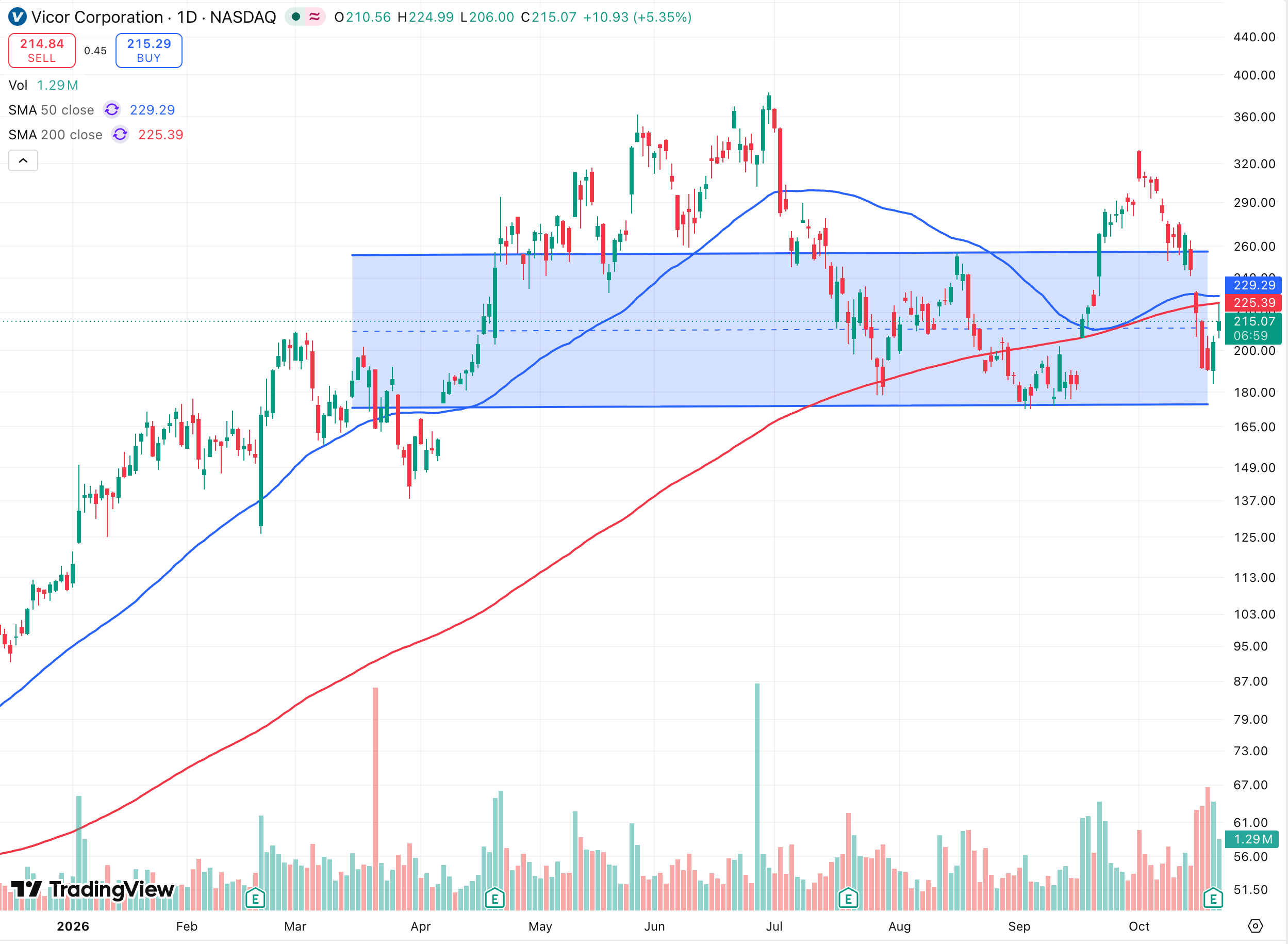
From a technical perspective, this stock is extremely volatile. In just a two-week span, it can easily rally past $300 and dump right back below $200, because it is hyper-sensitive to datacenter developments.
While its modules are utilized across automotive, defense, and aerospace applications, datacenters are the true cash engine for $VICR, driven by a multi-year partnership with NVIDIA, and now joined by Cerebras. As a result, the stock reacts violently to any headlines hinting at an AI infrastructure slowdown, as seen with the recent Gartner report.
As long as the datacenter boom continues, the company will be in good shape - its backlog covers two quarters and keeps expanding. The other sectors it operates in cannot offset a potential slowdown in AI. At the same time, the company is generating more revenue from licensing, and its conservative management prefers to underpromise. After the previous earnings report, the stock took a hit because of manufacturing capacity constraints, but that bottleneck has now been resolved.
Another thing that can be said with certainty is that there is no need to rush here. The stock is currently approaching its 200-day and 50-day moving averages, and until it firmly consolidates above them, there is always a risk of a pullback toward the 180 zone, a level it has defended well.
The company holds $500M in cash and has a strong aversion to debt. Consequently, interest rate hikes have no direct impact on its financials. However, if rising rates lead to a broader economic slowdown or cool down the AI infrastructure sector, it could affect the business.
Therefore, during rate-hike cycles, it is best not to trade on emotion, but rather wait for an attractive entry point. In the case of VICR, I would not even rely on a breakout of the 200-day moving average, as the stock easily slices through that level in both directions.
Instead, I would look for an entry point significantly lower in this difficult environment
This publication is for educational and informational purposes only and does not constitute financial, investment, or trading advice. Readers are solely responsible for their own investment decisions. The author is long VICOR.
Royalty revenue jumping 119% quarter over quarter to $66.6M, with almost no cost of goods sold, explains the gross margin move from 58% to 68.3%. The open question is how durable that is if the Foxconn litigation or an ITC outcome shifts the licensing picture.