


The market is actively searching for the “next big thing,” and right now, the biggest bet is on robotics. Over the next few years, we will see a massive shift: from software chatbots on our screens to machines that can actually move and work in the physical world.
In this post, we want to look past the hype, understand who is actually building these robots, and find the smartest ways to make money from this trend.
The Main Roadblock is the Math
To understand where the market is going, we have to look at the numbers. According to a recent report by McKinsey, the biggest roadblock right now is the cost of components. Building a single humanoid robot currently costs anywhere between $30,000 and $150,000. For this technology to become truly mass-market, the cost of the hardware needs to drop below $20,000.
Why are robots so expensive? The industry is in a “pre-modular” phase. There are simply no standardized, off-the-shelf parts available. Robotics companies are forced to do almost everything themselves through vertical integration, or custom-design unique joints and mechanisms for every single robot. Under these conditions, scaling production rapidly is physically impossible.
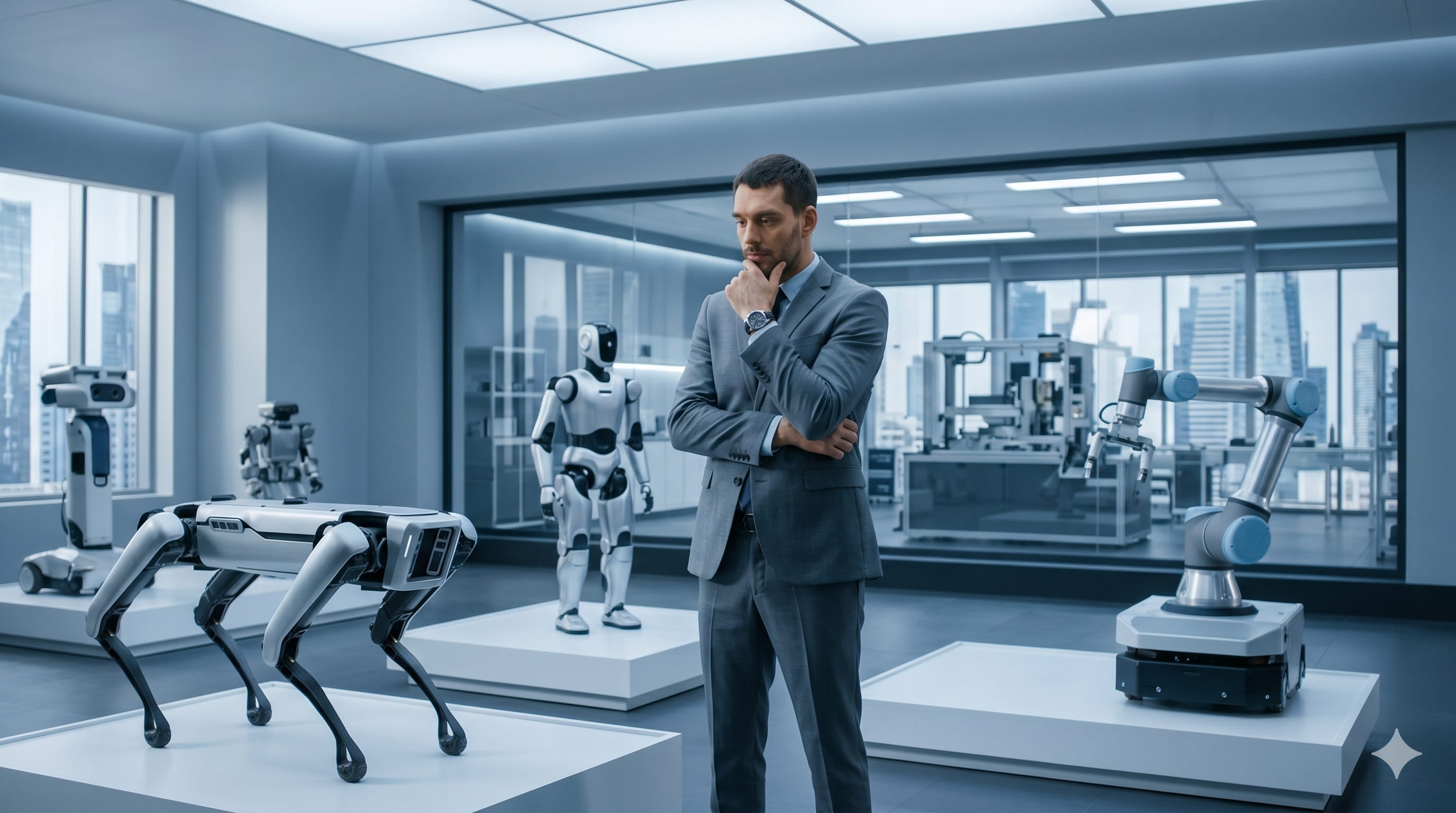
The Automotive Shortcut
However, robotics has a powerful accelerator: it can leverage the existing capacity and technologies of adjacent sectors. First and foremost, the electric vehicle (EV) and semiconductor industries.
To move and perform tasks, robots need the exact same batteries, sensors, chips, and motors as modern electric vehicles. This is precisely why China is moving faster than anyone else, they are building robots on the foundation of their highly developed EV manufacturing base.
Essentially, autonomous vehicle tech and robotics are merging into a single ecosystem:
Infrastructure and Brains: Nvidia is building the foundation for the entire industry. Their Isaac and Jetson platforms provide a ready-made environment where robots can train in digital simulations before deploying into the real world.
Robotic Vision: Autonomous driving tech is transitioning directly into robotics. Lidar manufacturer Ouster integrates its new Rev8 sensors with the NVIDIA Jetson and DRIVE platforms. This gives robots high-precision 3D vision and spatial awareness, technology originally built for self-driving cars.
Robots at Work: While humanoids are still in testing, other companies are already making billions on automation today. This includes Teradyne (TER), which owns Universal Robots (the market leader in collaborative arms), and Symbotic (SYM), which completely automates massive warehouses for giants like Walmart.
There are several ways to play this trend: through software and sensor manufacturers (like Nvidia or Ouster), established industrial automation plays (Symbotic, Teradyne), or unexpected backdoors in the traditional automotive industry, where the future giants of robotics are hiding.

The Industrial Scaling of Boston Dynamics
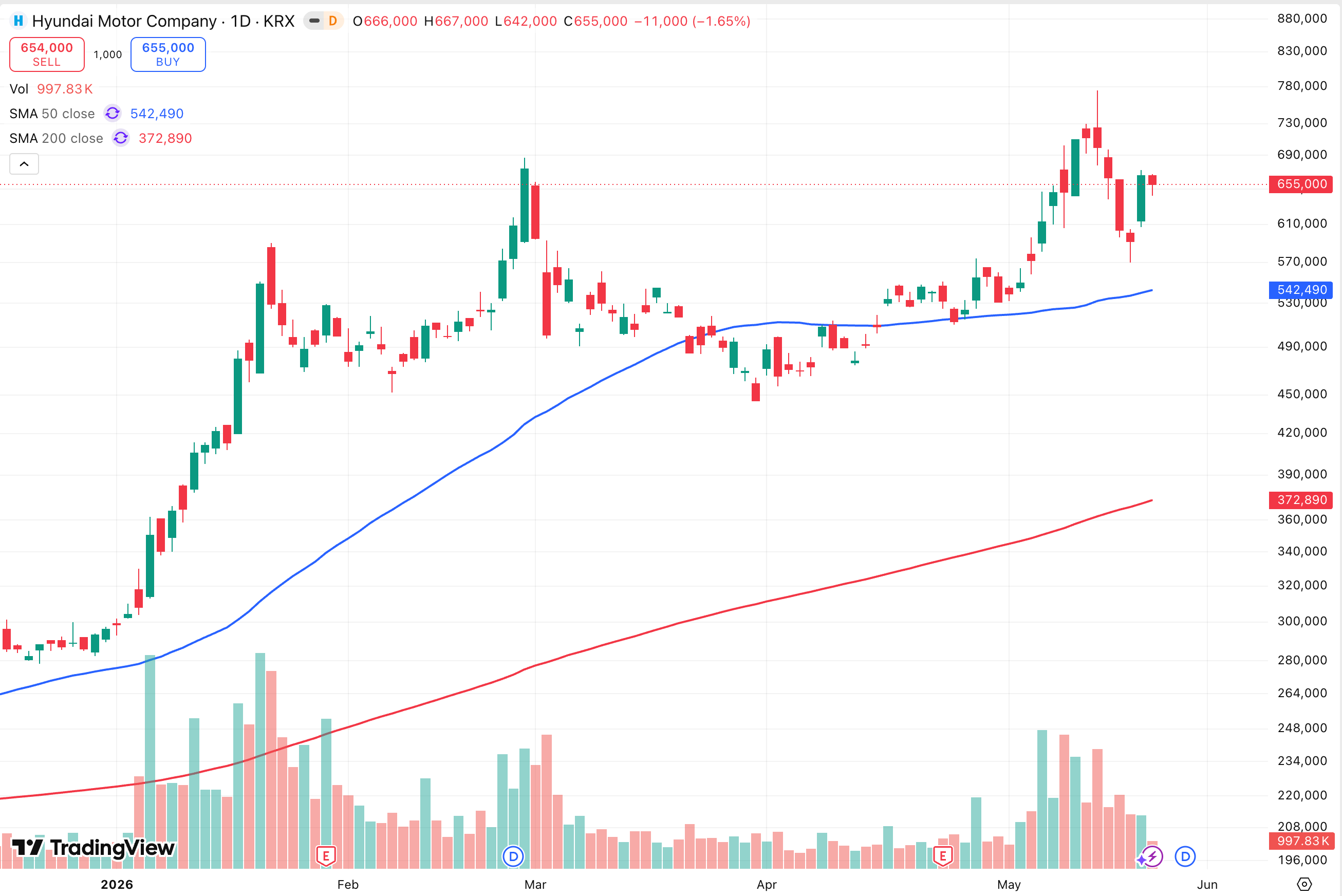
Boston Dynamics remains the industry benchmark for mechanical engineering and physical agility. Kia leadership recently indicated that the company is targeting an IPO by 2028 with an estimated valuation starting at $20-30B. Instead of waiting for the public offering and paying an investment-banking premium, investors can build exposure today through Hyundai Motor, which controls a 30% stake in Boston Dynamics.
This proxy provides a unique entry point because Hyundai is actively solving the project economics that sink most robotics startups. The structural flaw in the humanoid business model is the chicken-and-egg problem of volume: without massive orders, component manufacturers cannot tool up for cheap mass production, keeping robot costs high.
Hyundai is bypassing this issue by acting as its own anchor customer. The conglomerate is establishing a dedicated manufacturing system in Savannah, Georgia, with the capacity to produce over 30,000 Atlas units annually by 2028. Rather than selling these unproven machines to third parties, Hyundai plans to deploy over 25,000 Atlas robots directly onto its own and Kia’s automotive assembly lines.
This captive deployment model guarantees the volume necessary to force component suppliers to lower their prices. It also provides Hyundai with millions of hours of proprietary operational data, allowing them to refine the control algorithms in a structured, real-world environment.

Operating a humanoid robot also requires massive burst-power to handle heavy lifting and rapid stabilization. To meet these demands, the electric Atlas utilizes custom-engineered 46-series cylindrical NCM battery cells supplied by LG Energy Solution. This partnership highlights the direct advantage of leveraging scaled automotive battery manufacturing for robotic applications.
Beyond the operational integration, Hyundai Motor has historically traded at a deep discount, often referred to as the Korea Discount, due to its complex circular holding structure.
However, taking Boston Dynamics public on the NASDAQ in 2027 will require a major simplification of Hyundai’s corporate governance. This restructuring is highly likely to unlock significant trapped value for Hyundai Motor shareholders.
Dogs and human(oid)s
Spot
To understand the commercial viability of this enterprise, investors must analyze what these machines actually do in the field. Boston Dynamics has deliberately split the market into two distinct commercial forms, each addressing a specific operational pain point. The first is Spot, the quadrupedal robot dog that has been in serial production since 2020.
Spot is not designed for complex manual manipulation; its primary function is autonomous industrial inspection and anomaly detection in high-risk environments. Equipped with thermal cameras, radiation sensors, and acoustic imagers, thousands of Spot units are already deployed to patrol offshore oil rigs, electrical substations, and deep-mining operations where human presence carries a high insurance and safety penalty.