

Trust Issues: When CEOs Lie and Markets Cheer
SMCI's fantasy forecast, CrowdStrike's silence, and why investors need to stop falling for corporate theater

When you buy a stock, you’re handing your money to strangers. Some end up in prison like Nikola’s founder. Some take their secrets to the grave — like Enron. And some? They thrive. Like Charles Liang, CEO of SMCI.
SMCI became the poster child of retail greed. Nobody cared what was going on inside the company — just that it had once rocketed from $200 to $1200. AI hype, Nvidia tie-ins, liquid-cooled servers — who needs diligence when the chart looks that good?
But then came the unraveling.
In August 2024, Hindenburg Research accused SMCI of financial manipulation. The stock collapsed. By October, the U.S. Department of Justice stepped in. SMCI denied everything. Nvidia — its biggest partner — said nothing.
In November, Ernst & Young resigned as auditor. Delisting from Nasdaq became a real risk. (They had already been booted in 2018 for failing to file financials.)
And then? Magic.
Retail didn’t care. They believed. An internal probe found no wrongdoing. In February, Liang forecasted $40 billion in revenue. The stock more than doubled.
No real explanation. No accountability. But the market clapped anyway.
Traders sold everything else to load up on SMCI, hoping for another moonshot. That’s not investing — that’s emotional attachment. Tesla’s been promising robotaxis for a decade. People still believe.
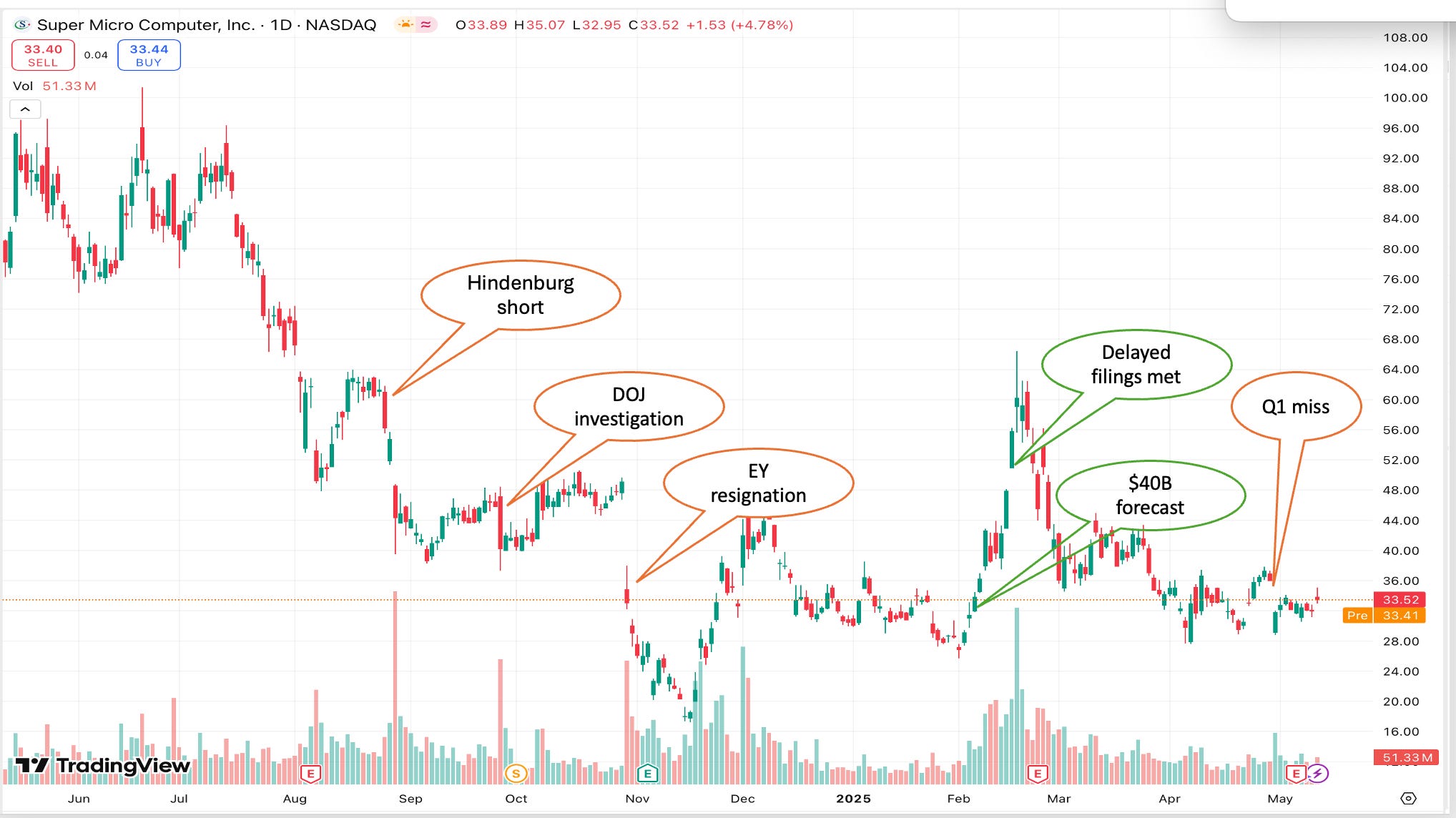
By March 2025, SMCI posted revenue of $4.6 billion — half the forecast. Net income: $108 million, down 77% year-over-year. Margins? Just 2.3%. They’re barely breaking even to stay ahead of Dell and HP.
Lesson? The only thing scarier than lies… is how willingly people believe them.
SMCI had a giant red flag years ago — delisted in 2018 for late filings. This time, history repeated with more zeros. And why? Because the market changed.
Once a stock makes you rich, you form a bond. You ignore red flags. You convince yourself it’ll come back. You don’t read earnings — you read tea leaves.
Management lies about forecasts because the market rewards them for it. And partners? They stay silent because it’s profitable. The more desperate your vendor, the better terms you get. Silence gets monetized.
Maybe that’s why margins are collapsing.
Investors had warnings. But they’ll blame tariffs or macro noise. It’s easier than admitting you bought into a fantasy.
Better to trust boring companies with conservative guidance… than be the last one holding the bag after a $40B dream turns to dust.
There was once another company that liked to smile through bad numbers.
Its name was Enron.
CrowdStrike: Silent Flights, Loud Red Flags
In a bizarre 2025 move, CrowdStrike’s founder quietly gifted over $1 billion in company stock to unnamed recipients, sharply reducing his control. No explanation. No transparency. And somehow, nobody blinked.
This came after a very public disaster: flight delays across the U.S. caused by CrowdStrike-related outages. Rather than own up or apologize, the company went quiet. Then it deflected. Then it argued with Delta.
Since then, the stock has rallied over 90%. But the real question isn’t “how high can it go?” — it’s “how long can this last?”
Because the issue isn’t just the screw-up. Mistakes happen. It’s the reaction — or lack thereof.
That silence became a pattern. In parallel, U.S. prosecutors began investigating what top executives knew about a shady $32 million deal between CrowdStrike and a distributor. They’re also probing other past transactions.
And then the question investors need to ask:
Are you okay putting your money in the hands of people like this?
Because scandals don’t knock on the door — they kick it in.
Nobody thought Nikola would fake their truck video either.
Salesforce & Apple: The Theater of Corporate Denial
During an earnings call, Salesforce CEO Marc Benioff used the word “fantastic” 32 times. The stock dropped anyway.
In the past five years, Salesforce is up just 58% — while the S&P crushed it. Revenue growth is slow. Profits are thinner than expected. But the presentations? Still full of buzzwords and theater.
That’s not leadership. That’s self-hypnosis.
Salesforce lives in a bubble: its software is everywhere, so it assumes it’s untouchable. Slap “AI” on every slide, talk about transformation, and hope no one checks the numbers.
Apple is no better.
While the rest of the world chases AI innovation, Apple’s big pitch? A better camera. Again. Investors tune in to hear about strategic direction — and get treated to lens upgrades.
And let’s not forget: Apple and Google are spending fortunes suing each other over browser defaults while millions of people are using ChatGPT instead.
Progress is happening elsewhere. They just haven’t noticed.
Nobody at Apple or Google is talking about hustle or reinvention — like Nvidia’s team constantly does. There’s no urgency. Just lifetime employment and boardroom comfort.
As Tony Fadell, who sold Nest to Google, once said:
“You were lucky if they even showed up… They’d take the bus in for lunch, get a massage, grab yogurt, and head home.”
He added: “Too much freedom breeds mediocrity. It will mess up your culture if you hire 15-year career Googlers.”
And when former Google exec Eric Schmidt said the company missed the AI wave because of remote work… he had to delete the post.
Only, you can’t delete your stock position as easily.
If you’re still holding Google — or Apple — ask yourself: what are you really buying? A vision? Or just another camera upgrade?
This publication is for educational and informational purposes only and does not constitute financial, investment, or trading advice. Readers are solely responsible for their own investment decisions. The author may hold positions in the securities mentioned.