

The EU’s NATO Breakout: Strength or Self-Destruction?
A new defense order is forming in Europe, but it may come at the cost of the Union itself

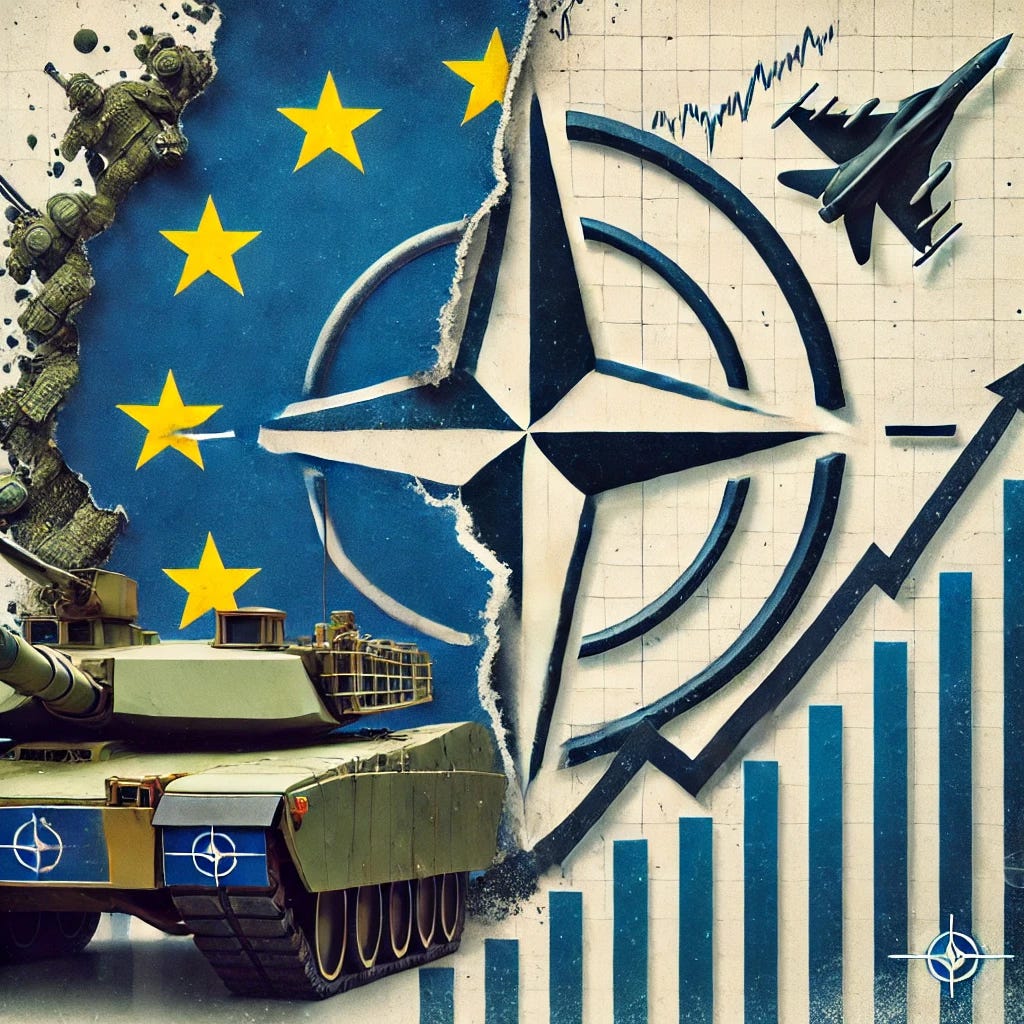
Europe is finally preparing for life without the U.S.—and the plan is bigger than anyone expected. A new military bloc, a defense spending surge, and a break from NATO as we know it. The EU isn’t just talking about independence anymore—it’s moving fast. This marks a tectonic shift in EU defense policy—one that could trigger even more drastic changes.
The EU and London are proposing a 5–10 year transition period, but they may not have that luxury. If the classic philosophical problem of a man chasing a turtle applied here, and Europe were the man, modern math wouldn’t exist—the turtle would have already won.
The EU’s Structural Weakness: Too Slow for Crisis Mode
The problem is that the EU's consensus-driven model is inherently sluggish, making it ineffective in high-stakes situations. Decisions by committee and anonymous voting act as a time bomb, slowing down urgent defense measures. The only viable path forward? A defense umbrella led by the wealthiest and most militarized European nations, replacing the U.S. with their own funding and faster procurement processes.
This won’t bring the UK back into the EU politically, but it will drag London into Europe’s new military order. Defense spending is the new power currency, and Britain—with its massive budget and security infrastructure—can’t afford to stay out. Today, we already see deepening cooperation between Poland and the UK, with Warsaw spending 4.7% of its GDP on defense—the highest in the Western world, apart from the U.S.
European Defense Stocks Set to Dominate
Money will inevitably flow into European defense firms, particularly those in the UK, Germany, and France. Yet, the combined market capitalization of these companies is shockingly low—smaller than luxury giant LVMH.
Rheinmetall (Germany) is worth just $50B—six times less than Novo Nordisk (NVO) and twice less than Lockheed Martin.
BAE, Thales, and Leonardo are poised to become Europe’s largest companies as defense budgets surge.
MBDA, Europe’s missile giant, will likely IPO, further boosting EU capital markets.
This defense boom will create jobs, boost economies, and weaken far-right parties like AfD, which thrive on insecurity and government incompetence. But more than that, it raises a bigger question: What’s next?
Is This the Birth of a Two-Speed Europe?
For decades, Europe moved at the speed of consensus—too slow to handle real crises. But now? The power players aren’t waiting. A ‘Fast Europe’ is emerging, where the biggest military spenders call the shots. And if weaker nations can’t keep up? They get left behind.
A logical outcome would be the formation of a "Fast Europe"—a coalition of militarized, economically powerful nations moving ahead on defense while the rest of the EU lags behind. This could lead to:
Schengen and the Eurozone becoming the only unifying elements of the EU.
The end of anonymous voting, with military-heavy countries leading decision-making.
A transactional Europe—where nations contribute or get left behind.
Trump’s Paradox: Weakening the EU by Making It Stronger
If Trump pulls the U.S. away from NATO, it might do what decades of EU diplomacy failed to accomplish—force Europe to finally take its own security seriously. In a strange paradox, his transactional approach might be more effective than years of vague promises and bureaucratic inertia.
The EU as we know it won’t collapse—it will mutate. The old, consensus-driven structure is dying. In its place? A Europe led by military power, economic strength, and cold, hard pragmatism. If Trump pulls the U.S. away, he may not just weaken the EU—he may create a stronger, faster version of it.
This publication is for educational and informational purposes only and does not constitute financial, investment, or trading advice. Readers are solely responsible for their own investment decisions. The author may hold positions in the securities mentioned.