


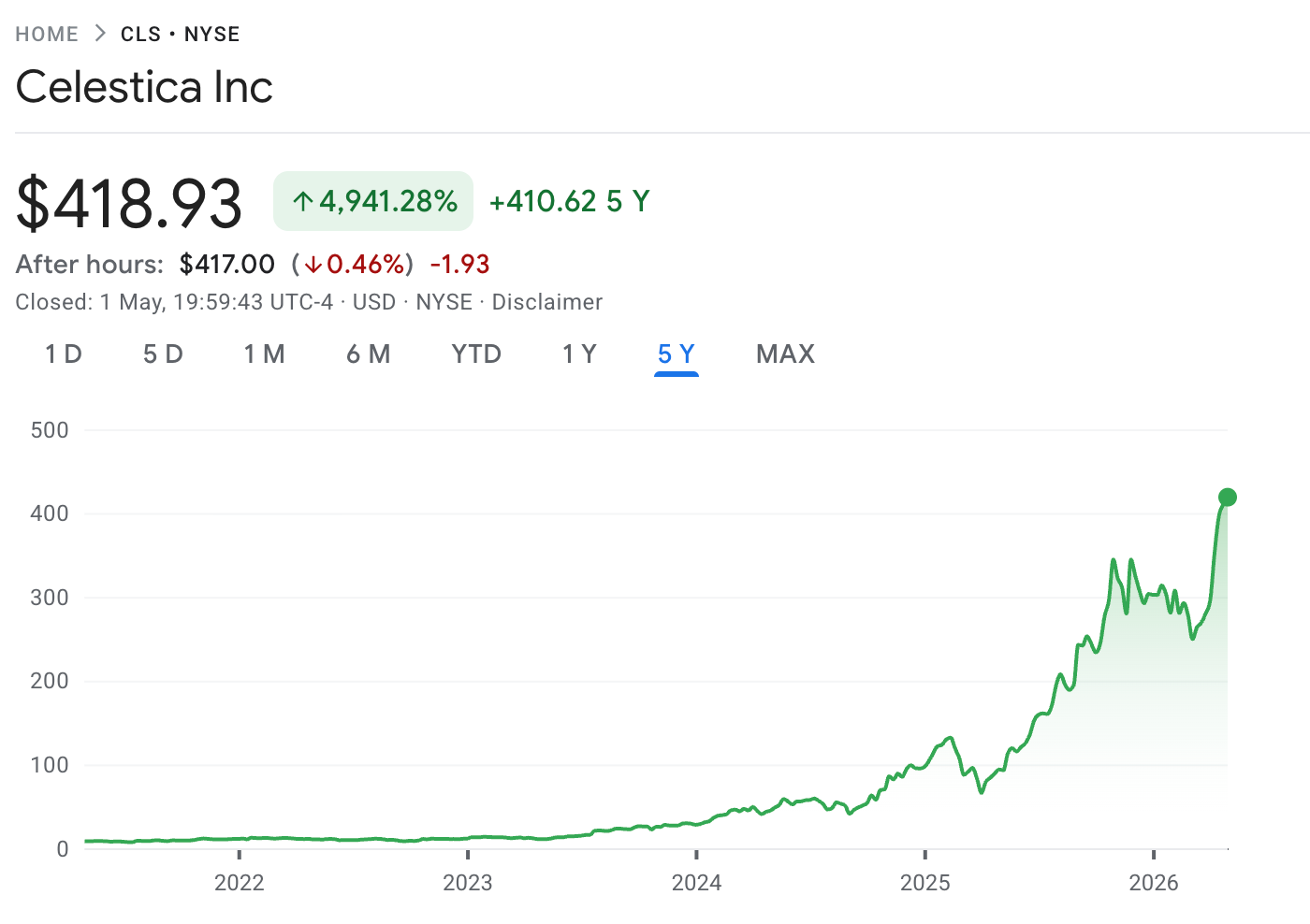
We are used to looking for the “next NVIDIA” among semiconductor startups, but true transformation often happens where no one expects it. Canadian company Celestica is a perfect case study of how a boring contract manufacturer from the 90s, left to gather dust on the market’s sidelines after the dot-com crash, reinvented itself to become a key partner for Google and other cloud giants.
It is worth writing about not just because its stock has quadrupled. It is important as a pattern: CLS 0.00%↑ demonstrates how a classic manufacturing base, accumulated since its 1998 IPO, can be transformed into a high-tech R&D hub under the right management.

If the AI boom teaches us anything, it is that the exponential development of technology constantly reveals new bottlenecks. The winners are those ready to clear these bottlenecks in real-time.
We previously covered Vicor, which solves the critical issue of chip power by converting current right at the foot of the processor. Now, we are moving further along this technological value chain. Celestica is the logical next step because it integrates disparate components, chips, power, and cooling, into a single, functioning system.

Network Breakthrough: The 400G -> 800G -> 1.6T Evolution
To understand the surge in Celestica shares, one must look at server ports in data centers rather than stock charts. Until 2023, Celestica was just one of many companies assembling standard network equipment. But as AI models began to grow exponentially, the network became the primary bottleneck for progress.
2023: The 400G Era and the Awakening
In 2023, the market realized that NVIDIA H100 chips are useless if they are connected by slow wires. A massive transition to the 400G standard (400 gigabits per second) began.
Why this helped CLS: At this exact moment, Celestica began aggressively offering its ODM solutions. Hyperscalers (primarily Google) realized it was more profitable to order designs directly from Celestica than to overpay for the Cisco brand. This provided the first powerful boost to revenue that we saw on the stock chart.
2024–2025: The Great 800G Transition
We are currently in a phase where 400G is no longer enough. Training models like Llama 3 or Gemini requires 800G.
The problem that emerged: At 800G speeds, ordinary signal transmission over copper cables begins to decay at a distance of a couple of meters. The signal simply falls apart. Celestica’s solution: The company brought its flagships to market (like the DS series seen in the photos).
They were the first to learn how to build systems where the signal remains clean even at such insane data density. The 69% growth in the Communications segment in the last quarter is a clear victory for 800G programs.
1.6T: The Physical Limit and New Architecture
Right now (late 2025 – early 2026), Celestica is launching 1.6T programs (1.6 terabits per second). Here, engineers have hit a wall that creates a moat around the company’s business.
The main problem - Thermal Apocalypse: At 1.6T speeds, switch chips (such as Broadcom Tomahawk 5/6) generate so much heat that air can no longer dissipate it. The server turns into a blast furnace. The technological response: Celestica developed the DS6001 model (seen in the screenshot).
This is a hybrid solution: CPO (Co-Packaged Optics): Optical fibers are brought close to the chip, replacing copper. Liquid Cooling: Liquid circulates inside the switch. Why this is important: Making such a piece of hardware reliable at a scale of thousands of units is a task that only 2 or 3 companies in the world can solve. Celestica is one of them.
The turning point came when Celestica's management realized the destructiveness of the "EMS trap", a business model where you compete with other factories only on who can solder someone else's chip to someone else's board for the lowest price. To break this cycle of penny-thin margins, the company made a strategic decision to transform into an ODM player by establishing the HPS (Hardware Platform Solutions) division.