

Sergey Brin Would Get Sued Here: Why the EU Can’t Outwork Anyone
You can’t build the future if no one wants to answer the phone after 5 p.m. The EU’s real crisis is deeper than policy.

The EU is in serious trouble. Despite massive defense packages, its economy continues to lag behind the U.S. and China. The Munich-based Ifo Institute now expects Germany’s GDP to expand by just 0.2% this year—down from 0.4% in January. Even a historic €1 trillion defense and infrastructure package can’t jolt the economy back to life.
Why? Because in the work/life balance equation, life won. People clock out at 5 p.m. sharp, and good luck getting anything done after that. Need a car fixed? Doctor? Electrician? You’ll need an appointment, and you’ll be waiting. In some smaller EU countries, basic services are a bureaucratic mess. Online infrastructure is outdated or non-existent.
The culture doesn’t reward hustle. I know someone working in a massive EU company where the vibe is “family forever.” Fire someone? Forget it—the law protects everyone. Add in layers of corporate fluff, and you get long days filled with ESG checklists and diversity workshops, not productivity.
If Sergey Brin proposed working 60 hours a week here, he’d be sued before his laptop could boot. Labor protections, rigid hours, and workplace sensitivity rules kill agility.
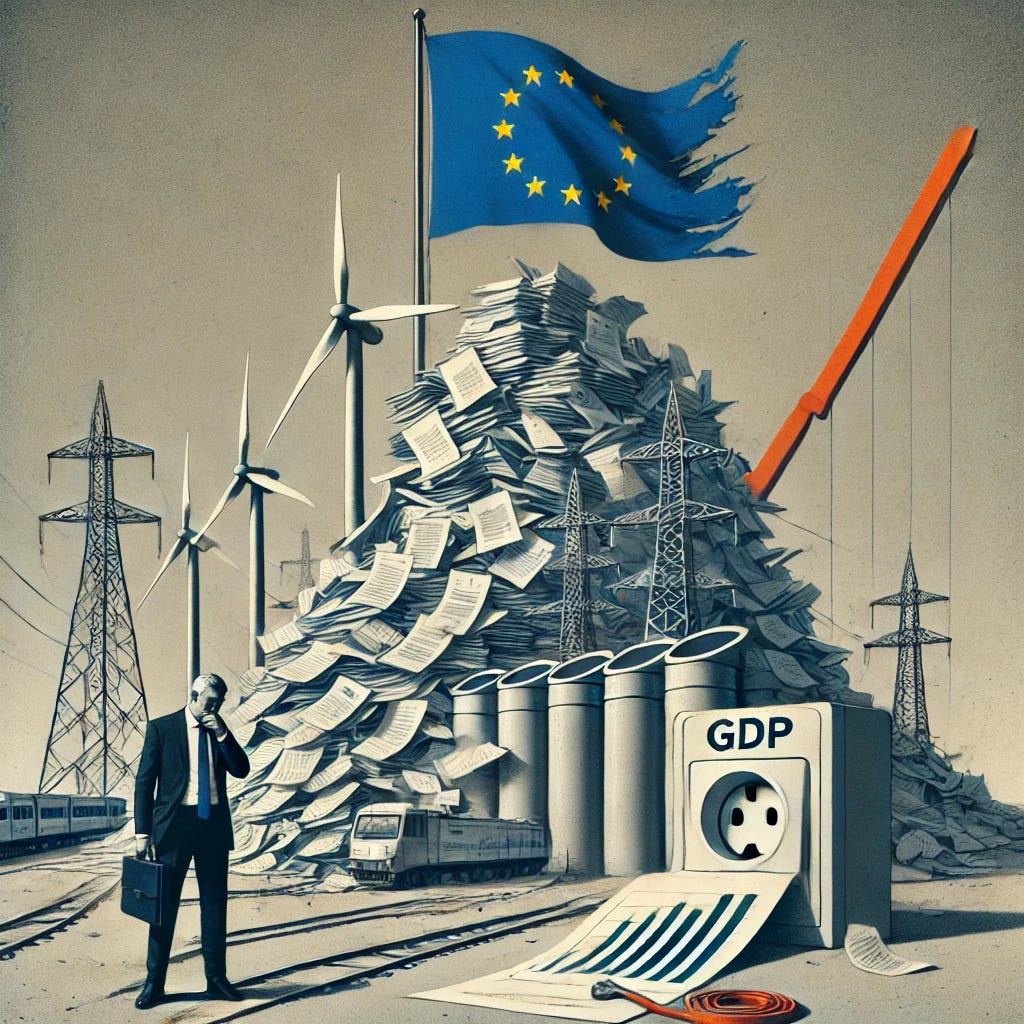
Meanwhile, the U.S. is scaling up fast. It keeps nuclear plants running while Big Tech dumps billions into powering data centers. U.S. GDP rose 2.8%, compared to 0.9% in the EU. American startups raised $213 billion in venture capital; Europe got $51 billion. A nearly 4x gap.
Europe functions like a giant family-owned business. That’s why I’m skeptical Brussels can leapfrog ahead and reduce dependency on the U.S. What the EU needs is to cut regulation and stimulate private investment. But who wants to fight red tape?
Name five big EU AI companies. You’ll say Mistral and then draw a blank. Apple can’t even roll out AI features due to regulation. Meanwhile, EU defense stocks like Rheinmetall—which gained 800% in three years—are still only worth €60B. Saab? €20B.
Eutelsat is nearly a penny stock. Its one lifeline? Elon Musk delaying Italy’s Starlink deal. Yes, that’s the same Italy whose leader has a chainsaw bromance with the MAGA crowd.
Mwb Research analyst Jens-Peter Rieck thinks Berlin could buy a stake in Rheinmetall for national security. State money, again.
Brussels is struggling to respond to Trump’s blunt challenge—and JD Vance’s even blunter one. Defense budgets are ballooning. Plans to replace the U.S. in NATO are underway. But without real structural reforms and political will, it’s all performative.
Eventually, someone in Europe will ask the same question that sparked Brexit and Vance’s wake-up call:
“Why are we still doing this?”
And if the answer is just “because we always have,” then this whole structure might not survive the next political cycle.
This publication is for educational and informational purposes only and does not constitute financial, investment, or trading advice. Readers are solely responsible for their own investment decisions. The author may hold positions in the securities mentioned.