

POET Technologies: Multibagger in the Making or Another Speculative Chip Play?
A deep dive into the Canadian photonics company betting on chip-scale optical integration to power AI data centers—and whether the technology can translate into a scalable business.

The Invisible Bottleneck in the AI Revolution
While the world obsesses over NVIDIA’s GPUs and the latest large language models, there’s a critical infrastructure problem that threatens to choke the entire AI revolution: how do you move data fast enough between chips without melting your data center?
POET Technologies (NASDAQ: POET) has positioned itself at the exact intersection of this problem and its solution. With $73 million in cash and a technology platform that promises to “semiconductorize” photonics, the company is making a bold bet that light, not electrons, will power the next generation of AI infrastructure.
The question for investors: Is this a legitimate breakthrough technology poised to capture a massive market, or another cleantech-style promise that will burn through capital before reaching profitability?
Understanding the Technology (Without the Physics Degree)
The Problem POET Solves
Modern AI systems face a fundamental physics problem. As data centers scale to handle ChatGPT, Claude, and countless other AI services, they’re hitting three walls simultaneously:
Speed limits: Electronic connections can’t transfer data fast enough between GPUs and memory
Heat generation: Moving electrons generates enormous heat, requiring massive cooling infrastructure
Power consumption: Data centers are consuming city-sized amounts of electricity
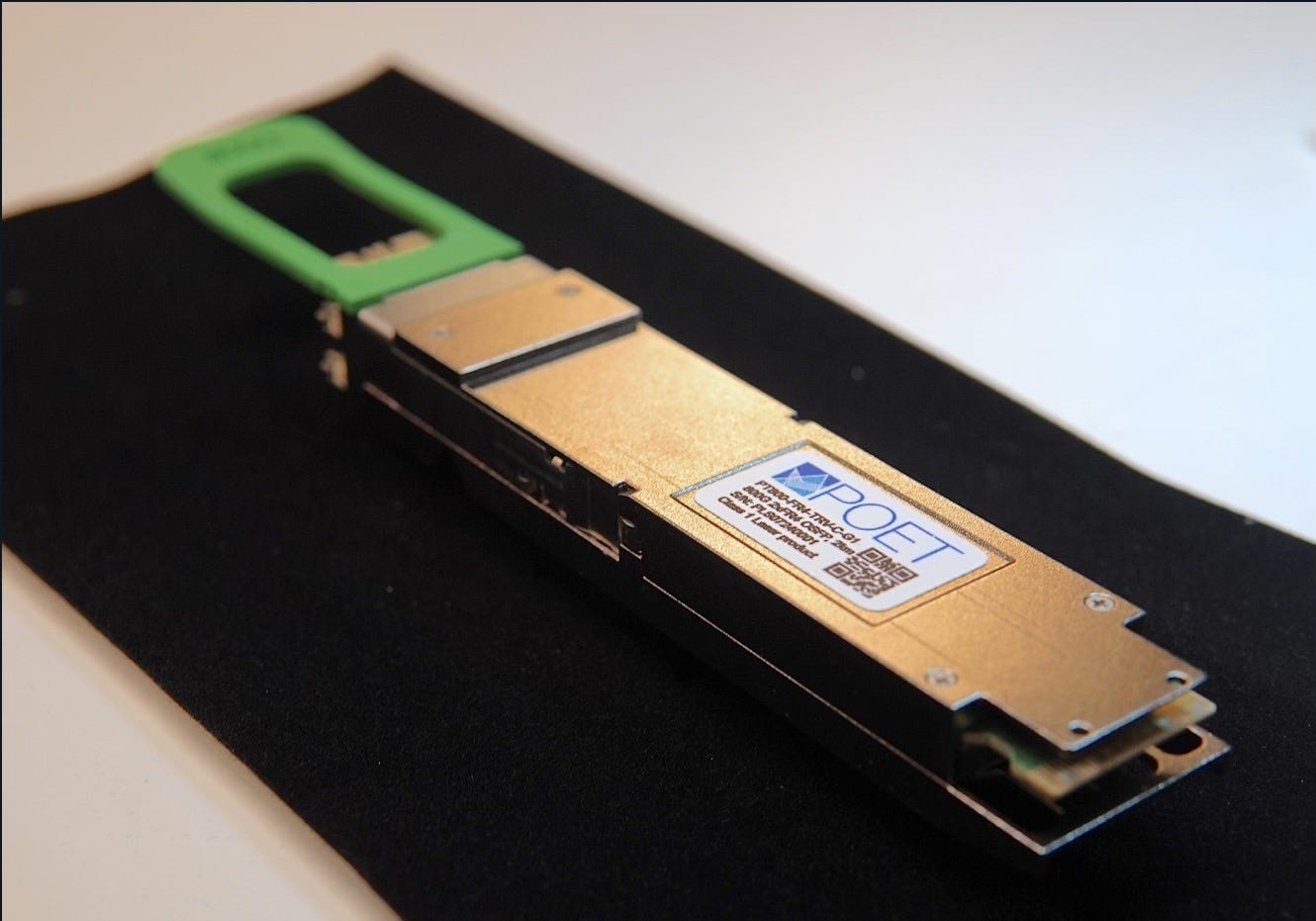
Traditional optical transceivers—the devices that convert electrical signals to light for fiber optic transmission—are expensive, complex assemblies built like tiny machines rather than chips. They require manual assembly, alignment, and testing of individual components.
The Origins: University of Connecticut and Dr. Geoff Taylor
POET Technologies didn’t emerge from a Silicon Valley garage or a venture-backed accelerator. Its roots trace back to 18 years of research at the University of Connecticut, where Chief Scientist Dr. Geoff Taylor and his team developed the foundational POET (Planar Opto-Electronic Technology) platform.
Dr. Taylor holds a Ph.D. and M.A.Sc. in Electrical Engineering from the University of Toronto and a B.Sc. from Queen’s University. His academic work laid the theoretical groundwork for integrating photonics and electronics—a problem that had stumped the semiconductor industry for decades.
The technology was initially commercialized through OPEL Technologies Inc., founded in 1972 (making the corporate entity over 50 years old). OPEL started in solar photovoltaics before pivoting entirely to photonics. In June 2013, after divesting its solar operations, the company renamed itself POET Technologies Inc. to reflect its singular focus on the optical interposer platform.
The Transformation: Enter Dr. Suresh Venkatesan
The pivot from academic research project to commercial semiconductor company required a different kind of leadership. In 2016, POET brought in Dr. Suresh Venkatesan from GlobalFoundries, where he had served as Senior Vice President of Technology Development.
Why Venkatesan matters: He’s not a researcher playing CEO. He’s built billion-dollar production lines at one of the world’s largest fabs. He knows how to scale semiconductor manufacturing from prototypes to volume production—exactly what POET needs.
In his own words from a recent interview: “Honestly, technology doesn’t mean anything unless you can manufacture it. So our focus really this year has been to cross that last hurdle of ensuring that the technology that we’re developing is truly manufacturable at scale and at wafer scale.
Recent Addition: Manufacturing Heavy Hitter
In May 2025, POET appointed Dr. Ghazi M. Chaoui as Senior Vice President of Global Manufacturing and Digital Transformation. Dr. Chaoui most recently served as Chief Procurement Officer at Coherent Corp. (a major photonics player).
This hire signals POET’s shift from pure R&D to scaled manufacturing operations—you don’t bring in a CPO from a major photonics company unless you’re expecting volume orders.
The Early Years: Building the Foundation (2017-2019)
POET didn’t start as a photonics company. The predecessor, Opel Solar, pivoted from solar technology into optical components. In 2017, POET began designing lasers for data communications and directed DenseLight Semiconductors (their Singapore-based subsidiary) to build devices compatible with what would become the Optical Interposer platform.
By 2019, management made a critical strategic decision: adopt a “fab-light” strategy. Instead of owning expensive fabrication facilities, they would focus on design and IP while outsourcing manufacturing—similar to how Nvidia designs chips but doesn’t own fabs.
They sold DenseLight in November 2019, divesting their main operating asset to focus purely on the Optical Interposer platform. This was a gutsy move: give up guaranteed revenue to bet everything on an unproven technology.
The China Chapter (2020-2024)
From 2018-2020, virtually all R&D spending went into developing the Optical Interposer as a versatile platform. But they needed manufacturing capacity.
Enter the China joint venture: Super Photonics Xiamen (SPX), a partnership with Sanan IC. This gave POET access to fabrication capabilities and the massive Chinese market. By late 2024, POET owned 75.2% of SPX.
But geopolitics intervened. U.S.-China tensions, export controls, and supply chain security concerns made the China operation increasingly risky. Major U.S. hyperscale data centers wouldn’t buy components with Chinese manufacturing exposure.
The Great Migration (2024-2025)
POET made the expensive decision to exit China entirely:
Acquired Sanan IC’s remaining 24.8% stake in SPX for $6.5M (payable over 5 years)
Transferred all production equipment to Malaysia
Established partnerships with Globetronics and NationGate in Penang
Closed SPX permanently (completed 2025)
The cost? Beyond the $6.5M payment, there was a $6.9M non-cash loss on the SPX acquisition, significant severance for the Chinese workforce, and months of operational disruption during the transition.
The benefit? Clean supply chain for U.S. customers, operational control, and reduced geopolitical risk.
Keep reading with a 7-day free trial
Subscribe to Edge of Power to keep reading this post and get 7 days of free access to the full post archives.