
Talen Energy locks in $805 million — utilities rally hard
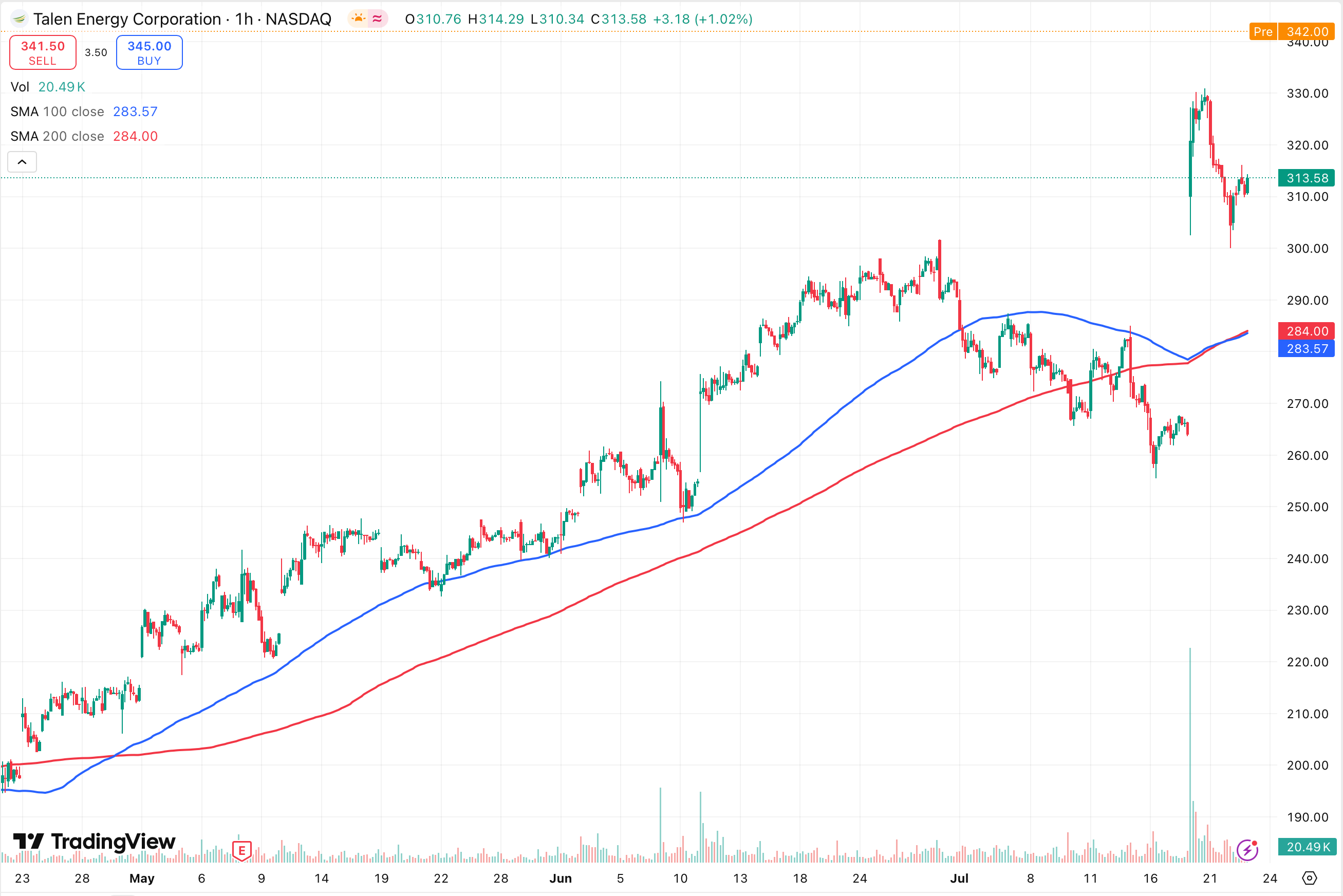
Talen Energy ($TLN) just bagged a huge win in the PJM capacity auction, locking in $805 million in future payments for keeping 6,702 megawatts of power on standby during the 2026–2027 planning year. The clearing price? A stunning $329/MW per day, more than triple the level seen just a few years ago — signaling tight energy supply and rising grid stress.
Talen is more than 50% YTD, +9% at $342
This auction result sparked a rally in utility names:
Vistra ($VST) +5.6%
Constellation ($CEG) +4%
Oklo ($OKLO) +2.7%
But Talen’s momentum didn’t start this week. Back in June, the company expanded its nuclear energy deal with Amazon, agreeing to supply up to 1,920 megawatts of carbon-free electricity through 2042 — powering AWS’s massive AI-focused data center campus. The two also plan to explore Small Modular Reactor (SMR) tech at the Susquehanna site.
In short:
Talen now has long-term revenue from Amazon
And short-term upside from the capacity auction
While riding the macro tailwind of rising AI/data energy demand
This name went from overlooked to overpowered — and Wall Street is waking up.
🚨 Oscar Health is downgraded to $11 by Barclays — and worse, it was earned
Just a day ago, Oscar Health ($OSCR) tried to reassure the market. The company lifted its full-year revenue guidance to $12.1B (vs prior $11.25B), signaling stronger member growth and premium volume. That alone sent the stock up — until the rest of the numbers came into focus.
Oscar now expects a Q2 operating loss of $230 million, a staggering reversal from previous expectations of $55 million in operating income. Full-year guidance was also flipped on its head: instead of a projected $250 million profit, Oscar now sees a $250 million operating loss.
The trigger? A risk adjustment review by actuarial firm Wakely revealed that the company significantly underestimated how much it would owe in ACA risk transfer payments — essentially a penalty for attracting too many high-risk patients relative to peers.
As a result, the company's medical loss ratio (MLR) — the % of premiums spent on claims — is now projected at 86.5%, up from 81.2%. For an insurance company, that’s the difference between skating by and burning through cash.
Barclays responded today by slashing their price target from $17 to $11 and downgrading the stock. Piper Sandler already looked cautious last week, reiterating $14.
Oscar’s revenue growth is real — and likely sustainable in ACA markets — but profitability is clearly not. Until this company finds a way to bring down costs and smooth out its exposure to unpredictable risk pool payments, it will remain a high-burn, low-margin operator in one of the most volatile corners of U.S. healthcare.
AEVA’s LiDAR Lands at Tampa Airport — and Wall Street Is Watching
Aeva Technologies (NASDAQ: AEVA) just got a boost of real-world validation. Tampa International Airport has started deploying AEVA’s 4D LiDAR sensors as part of a broader initiative led by Sotereon.AI (formerly The Indoor Lab) to improve airport safety, operations, and traveler experience.
But this isn’t just a tech trial — it’s a commercial use case in a major U.S. airport. And in a market that’s often skeptical of unproven SPAC-era hardware startups, stories like this give new credibility to AEVA’s vision of sensor-based infrastructure.
The stock rose 2.3% on the news, trading at $26.45. With a market cap of $1.42B, AEVA still trades at a steep discount to its SPAC highs — but that might be changing. Oppenheimer sees 40% upside with a $36 price target, as Wall Street looks for signs that AEVA is transitioning from R&D to revenue.
This could mark a turning point — from speculative tech to government and infrastructure adoption. If airports bite, expect more institutional attention.
Oklo and Liberty Energy Partner on Hybrid Power Strategy — Investors Watch for Revenue Traction
Oklo (OKLO), one of the market’s most ambitious nuclear startups, has teamed up with Liberty Energy (LBRT) to offer hybrid energy solutions combining natural gas and future nuclear capacity. The announcement comes as energy-intensive sectors like AI data centers and crypto mining ramp up demand for uninterrupted baseload power — a perfect test case for Oklo’s yet-to-be-deployed Aurora reactors.
Oklo went public earlier this year via a SPAC merger and quickly surged to a $1.4B valuation. Since then, the stock has seen high volatility, fueled by speculative interest in small modular reactor (SMR) technology and government support for advanced nuclear. Shares are currently trading around $10, down from highs near $16, as investors wait for the company to deliver real-world progress beyond press releases.
Liberty Energy (LBRT), by contrast, is a profitable oilfield services firm with a $2.8B market cap and a more traditional customer base. It’s up 27% YTD, riding a wave of energy sector optimism and cost-saving partnerships. The deal gives Liberty a potential future hedge on decarbonization without abandoning its core cash-generating business.
This announcement is unlikely to move the needle much for Liberty in the short term, but for Oklo, it adds a layer of institutional credibility — and potentially a revenue pipeline — that speculators will appreciate. The market has rewarded these kinds of “vision + infrastructure” plays before, especially when there's a government or data center angle.
Bottom line: For now, this is a narrative boost for Oklo — not yet a revenue story. But if Aurora reactors get traction with commercial partners like Liberty, that could change fast.