


NVIDIA just broke every record again — and proved there are no limits.
For the first time in history, the company is guiding for over $50B in quarterly revenue: $54B vs $53B expected.
NVIDIA is the clear winner in the data center gold rush, capturing the lion’s share of the $300B hyperscalers are pouring into AI infrastructure. But the real shift? NVIDIA has stopped including China in its forward projections — signaling a permanent divorce. Chinese firms are now prioritizing state contracts and digital sovereignty over AI quality. That makes the AI race fully geopolitical — and NVIDIA is positioned as the central player.
CFO Colette Kress said the company expects to receive $20B+ from sovereign AI initiatives alone.
Minutes after earnings dropped, reports surfaced: Google is investing $9B in a Louisiana data center, and Meta is going all in with $50B.
NVIDIA’s own estimates? $3–4 trillion in global AI infra spending by 2030. That’s $700B per year.
If Jensen captures even $400B annually, this stock doubles from here.
NVIDIA could’ve kept the margins for itself by running cloud services — instead, it lets CoreWeave profit off its GPUs. Why? No one’s talking.
Q2 Earnings: $46.7B Revenue, up from $30.0B last year (+55%).
Net income: $25.8B (+30% YoY) EPS: $1.05 vs. $0.81 (+30%)
Gross profit: $33.9B (vs. $22.6B)
Data Center: $41.1B revenue, +56% YoY, +5% QoQ — still the engine of growth.
Outlook: Q3 revenue guide at $54B ±2%, GAAP gross margin ~73.3%.
Opex expected at $5.9B (GAAP) .
New products: RTX PRO 6000 Blackwell Server Edition announced, with early adoption by Disney, Foxconn, SAP.
LOST CHINA
📉 NVIDIA’s China business was once estimated at ~$50B, according to commentary on the earnings call. That’s now being written down — both internally and by the market.
Cambricon, one of China’s top AI chip firms, just reported a 4,000% revenue surge in H1 and swung to profit. This isn’t a one-off: it reflects Beijing’s accelerating push to replace NVIDIA with domestic players.
Despite earlier attempts to stay in China with downgraded chips, NVIDIA is effectively out of the market. Reports suggest the government is discouraging purchases from U.S. firms altogether.
The AI race is no longer just global. It's geopolitical. And NVIDIA is being erased from the second-largest AI economy. But the company found new opportunities.
I, ROBOT
Wall Street’s robot fanboys have been drooling over autonomous machines for years. They’ve priced in robotaxis, humanoids, warehouse bots — even if most of them still need a human babysitter. But now they finally have something real to talk about.
NVIDIA just dropped its GR00T platform — a full-stack solution for building general-purpose humanoid robots. It runs on the company’s Jetson Thor system-on-a-chip, paired with the same CUDA software stack and Omniversesimulation engine that dominates the AI world.
What’s the price? Around $3,000 — roughly the same as Apple’s Vision Pro. Except this isn’t some VR toy. It’s a plug-and-play robotics brain designed to train, simulate, and operate full physical agents in real time.

In typical Jensen Huang fashion, it’s not just a chip — it’s a way to lock down the entire robotics ecosystem. If you want to build a robot that actually works, you’ll need his hardware, his simulation tools, and probably his cloud.
Welcome to physical AI — and good luck competing.
NVIDIA announced partnerships with 1X, Agility Robotics, Sanctuary AI, Fourier Intelligence, and several other robotics startups. These are not hobby labs — they’re companies with working prototypes, real funding, and clearly defined commercial use cases.
· 1X is backed by OpenAI and focuses on human-like general-purpose robots. Their latest model, NEO, is already in testing for tasks like office reception and basic logistics.
· Agility Robotics is building Digit, a bipedal warehouse robot designed to work alongside humans in fulfillment centers. They’ve already partnered with Amazon for pilot programs.
· Sanctuary AI is pursuing full “human-equivalent intelligence” in robotics. Their robot Phoenix can already complete multi-step tasks like picking and packing in industrial settings.
· Fourier Intelligence has deep roots in rehab and assistive robotics in China, now expanding into industrial and humanoid applications with its GR-1 robot.
Together, these companies cover a wide swath of the emerging robotics market — from logistics to healthcare, from human interaction to repetitive labor. NVIDIA’s move to support them with a unified hardware/software stack means one thing: it wants to be the default operating system of robotics, the same way it became the OS of AI.
This isn’t just about chips anymore. NVIDIA is embedding itself at the foundation layer of an entirely new industry — one that could rival PCs or smartphones in market size and economic impact.
Market Size — Just the Tip of the Iceberg
The global service robotics market is on track to grow from $47 billion in 2023 to $108 billion by 2030, at a CAGR of ~12.6%
More bullish forecasts push the broader robotics industry up to $160–$260 billion by 2030
And if you zoom in on intelligent robots (think humanoids, surgical bots), Markets & Markets expects that segment to jump from $14 billion in 2025 to $50 billion by 2030 (CAGR ≈ 29%)
Morgan Stanley even projects $4.7 trillion in annual revenue and 1 billion units sold by 2050
🧠 GR00T + Jetson Thor: The Brain and Muscle of Next-Gen Robots
GR00T isn’t just another AI stack — it’s a universal foundation model for the physical world. Think of it as the GPT of robotics: trained on sensor data, video, human commands, motion telemetry, and more. Its goal? To let robots move, understand, and act in real-world environments — without hardcoded instructions.
It solves three core challenges:
Skill generalization – one robot learns, all others inherit the knowledge;
Human-robot interface – intuitive control via text, voice, and gestures;
Multimodal perception – fusing vision, LiDAR, audio, and tactile data to navigate complex spaces.
💡 But software alone doesn’t cut it — GR00T needs serious hardware. Enter Jetson Thor.
Jetson Thor is NVIDIA’s flagship system-on-chip (SoC) platform designed specifically for running robotics-scale foundation models like GR00T. Built on the same Thor architecture intended for autonomous vehicles, it's optimized for real-time, edge-level intelligence in robots.
Key specs:
800 TFLOPs compute (10x more than prior Jetson chips)
Onboard GPU built on Blackwell architecture
Native support for high-bandwidth sensor inputs — cameras, IMUs, tactile arrays
Real-time decision-making on-device — no cloud latency
💣 What this enables:
Robots that adapt instead of blindly execute
Behavior transfer from model to machine, no coding from scratch
A massive drop in time and cost for R&D and deployment
This is why every serious robotics firm — 1X, Agility Robotics, Fourier, Sanctuary AI, and others — is now aligning with NVIDIA. They’re not just customers; they’re building directly on this stack.
Manufacturers use GR00T to pretrain robotic behaviors and perception pipelines, then deploy those models on Jetson Thor for real-world execution. It's a closed loop: Train centrally, act locally — and improve collectively.
Bottom line: NVIDIA isn’t building robots. It’s becoming the operating system for robots.
PRICE TARGET: $220-250
📊 NVIDIA Valuation Snapshot (2025):
Q2 2025 Net Income: $13.5B
Q2 Revenue: $25.9B
Net Margin: ~52%
Annualized Net Income: ~$54B
EPS (Earnings per Share): ~$4.20
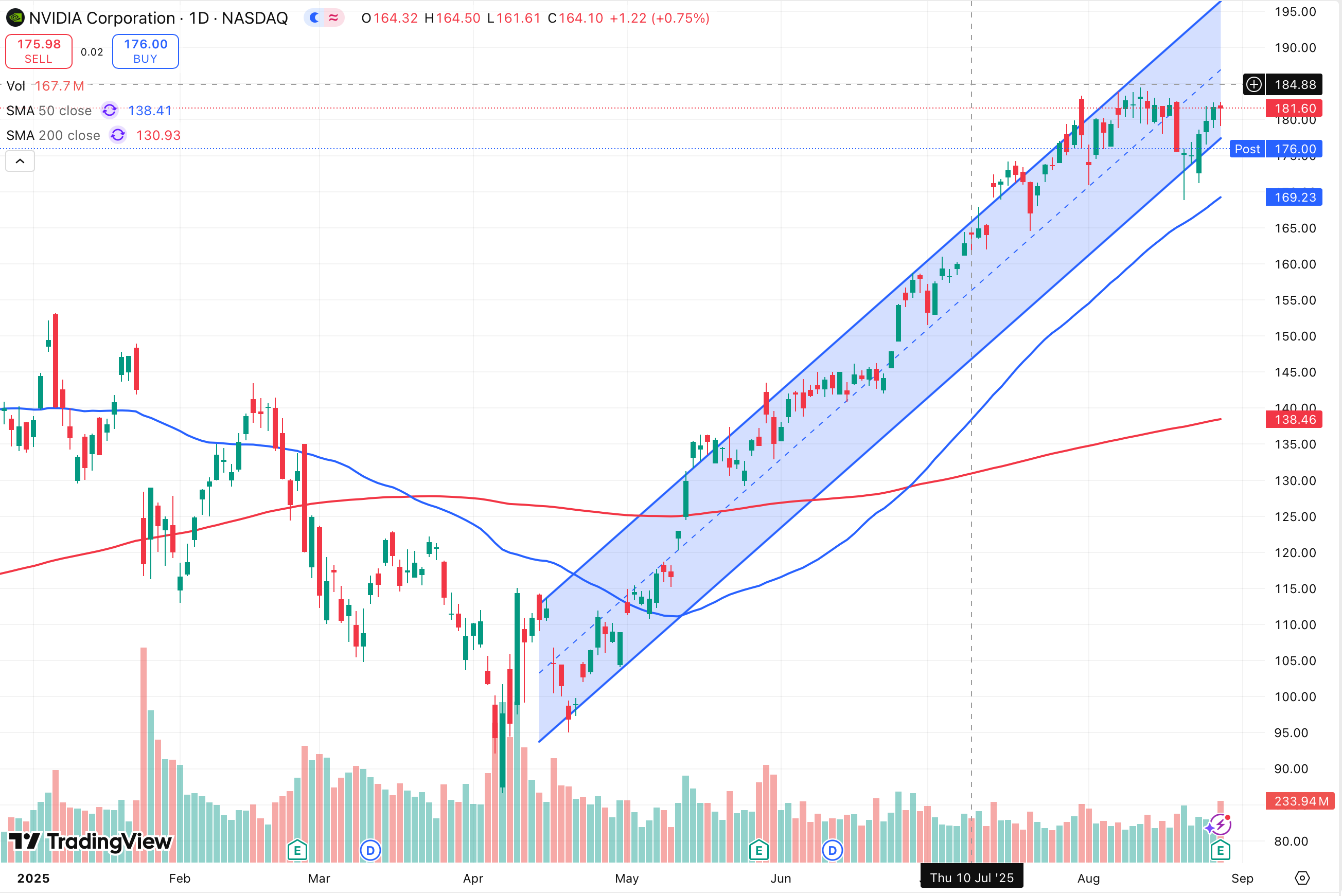
Current Share Price: ~$177
Implied P/E Ratio: ~42×
💡 What’s a Fair Valuation?
For NVIDIA, a P/E of 45–52 is considered reasonable — even conservative — given:
NVIDIA owns the AI infrastructure market with no serious challengers.
Revenue is growing 170% YoY — no signs of slowing.
It’s expanding into new sectors: robotics, sovereign AI, digital twins, industrial autonomy.
Hyperscalers are set to spend $300B+ this year on AI infra, and NVIDIA is taking the lion’s share.
🧮 Price Calculation (Simple Forward P/E Model):
$4.20 EPS × 45 = $189
$4.20 EPS × 52 = $218
➡️ Fair Price Range Today: $189–$218 per share
Based only on trailing earnings and conservative growth assumptions.
🚀 What This Tells Us:
If NVIDIA just maintains its current trajectory — with no surprises — $200–220/share by year-end looks realistic.
If the market starts pricing in future upside (robotics TAM, data center cycles, etc.), you’re looking at $250+ potential into 2026.
Either way, NVIDIA has become the Microsoft-on-steroids for the AI age — and this price range reflects its baseline value, not the ceiling.
A stock to own
NVIDIA could realistically reach $400 in the coming years, especially if datacenter spending is soon matched by robotics infrastructure. The company has shown remarkable resilience — it managed to offset lost China revenue in just a few months.
In terms of earnings, NVIDIA has already caught up with Meta. But Jensen Huang built more than just a product company — he built infrastructure. NVIDIA is now the foundation layer of the AI economy.
And let’s be clear: the minor drop after earnings is just a short-term reaction to a slight deceleration in datacenter growth. Long term, the stock is still aimed north of $200 — and probably much higher.
This publication is for educational and informational purposes only and does not constitute financial, investment, or trading advice. Readers are solely responsible for their own investment decisions. The author may hold positions in the securities mentioned.
Fantastic breakdown. The way you connect the earnings numbers to the bigger geopolitical and robotics play really stands out.
Keep up the good work! I'm rooting for you.