

Back in 2009, journalist Matt Taibbi famously described Goldman Sachs as a “great vampire squid wrapped around the face of humanity.” In the AI era, the squid has taken on a new form. Today, it is not Wall Street sucking fees from every transaction, but Microsoft quietly weaving a web of data centers across the globe. The new tentacles are made of GPUs, power purchase agreements, sovereign cloud regions, and AI contracts.
The adoption of Microsoft Copilot by the U.S. House of Representatives makes this transformation tangible. Copilot is no longer a productivity gimmick; it has become infrastructure, capable of running at the scale of entire state institutions. When Congress itself starts embedding Microsoft AI into daily workflows, it signals a profound shift — Microsoft is no longer just a vendor, but a critical systems partner for governments.
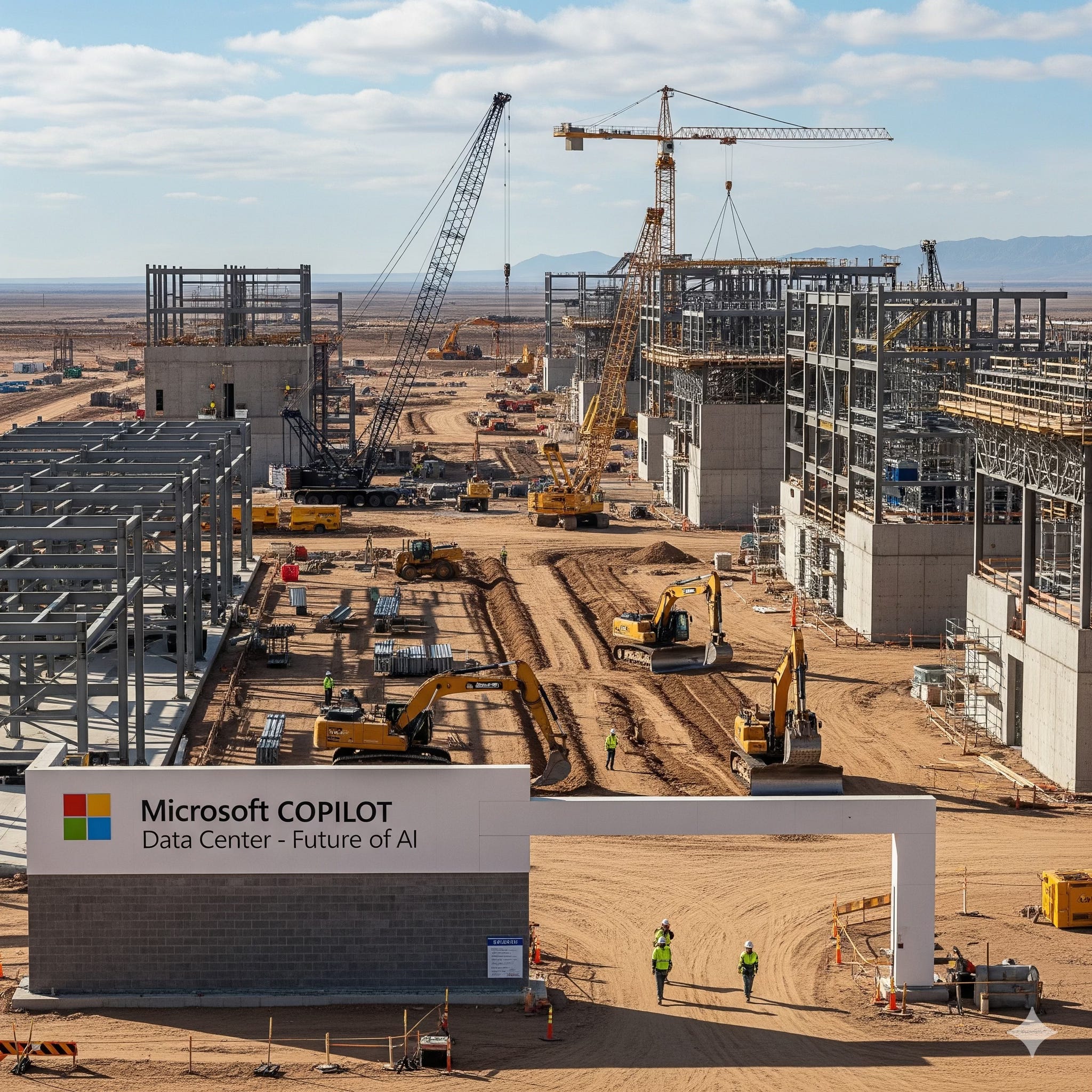
This move comes in parallel with some of the largest capital deployments the company has ever made outside the United States. In the U.K., Microsoft has committed close to $30 billion to build sovereign cloud regions and supercomputers for training frontier AI models. In Norway, together with Aker and Nscale, it is investing another $6.2 billion into a hydro-powered AI hub with capacity in the hundreds of megawatts.
And in the U.S., a $19.5 billion deal with Nebius secures GPU clusters for the next five years. Taken together, these three projects already represent more than $56 billion of pipeline, while overall CapEx for fiscal 2025 is forecast to approach $80 billion.
The Middle East adds another layer. In Saudi Arabia, Microsoft is building sovereign cloud regions aligned with the kingdom’s data strategy, ensuring the company sits at the heart of AI adoption in one of the fastest-growing digital markets. Meanwhile, in the UAE, Microsoft has forged a deep partnership with G42 — Abu Dhabi’s AI and cloud champion.
This alliance not only secures access to Gulf markets but positions Microsoft as the West’s strategic counterweight to Chinese technology influence in the region. By embedding itself into G42’s ecosystem, Microsoft effectively ties its infrastructure buildout to one of the most capital-rich and politically aligned AI projects in the Middle East.

The pattern is unmistakable. Norway for renewables and sovereign wealth alignment. The U.K. for European visibility and political partnership. Saudi Arabia and the Emirates for energy, capital, and geopolitical reach. Each investment is not just a new cluster of GPUs but a new node in Microsoft’s emerging global nervous system for AI.
And yet, the market response has been strangely muted. Investors rush into unprofitable players like NBIS and CoreWeave on the promise of AI exposure, while Microsoft — booking billions in contracts and hardwiring itself into sovereign strategies — trades as if these projects were ordinary CapEx.
This disconnect cannot last. With infrastructure of this scale, the company’s pricing power is not a question of “if” but “when.” A $600 share price by year-end is not aggressive; it is simply an acknowledgment of revenues already locked in and capacity already under construction.
It is a story of infrastructure that will feed Microsoft for decades. By combining its own cloud regions, partnerships with independent providers, and direct integration into government institutions, Microsoft is building the rails of the AI economy. The vampire squid of finance has been replaced by a digital squid — and its tentacles now reach across the world’s power grids, parliaments, and sovereign funds.
Microsoft’s global expansion is not tied to who sits in the White House. This is not just software — it is soft power. That’s why its investments span the globe, and alongside it follow Google and the rest of Big Tech. If they don’t come, China will — the same way Europe’s Wi-Fi backbone runs through Huawei.
Data centers cannot be cut off as easily as chip exports, especially since one is useless without the other. Microsoft today is as much a quasi-state actor as Boeing — sometimes even replacing government agencies. Just think: it is often Microsoft, not the FBI, that first reports on Chinese hacker campaigns. (Could Bill Gates have imagined this when he was building Windows?)
It’s also critical to understand that Microsoft is building the very infrastructure on which all other projects will be stacked — and this is where millions of NVIDIA chips will run. NVIDIA will do just fine without China, just as China will do without NVIDIA. Paradoxically, Jensen Huang has often thought more about China’s technological progress than Beijing itself. One could almost call him a patriot. But that’s another story.

Despite my enthusiasm for younger, high-growth companies that can multiply several times over, it’s giants like Microsoft that should anchor any portfolio. First, they’re less sensitive to interest rates. A hot startup can rally only as long as cheap credit flows; once banks tighten, the story often ends.
Second, Microsoft leads in innovation, and investments of this scale are simply too large not to generate returns over time. Third, MSFT is embedded in every major ETF — it will always be bought, and you don’t have to faint at the sight of another dilutive capital raise, like what spooked RKLB holders yesterday.
In other words, Microsoft doesn’t betray.
This publication is for educational and informational purposes only and does not constitute financial, investment, or trading advice. Readers are solely responsible for their own investment decisions. The author may hold positions in the securities mentioned.
A great read, i like the boeing comparison but did you surprise yourself you would be writing about MSFT? 😀