


Harmonic Drive Systems is up 70% YTD, finally clawing its way back to where it was four years ago at roughly $41 per share. The reason for this squeeze is simple: the precision gears the company is named after have suddenly become the most wanted hardware for humanoid robots.
This massive shift in demand has finally forced investors to pay attention to the stock. In this post, we will break down the company from its historical roots to its latest financials to see if its competitive moat is real, and whether it can actually justify its current price.
History
The underlying tech isn’t new. Clarence Walton Musser patented strain wave gearing back in 1955. Instead of using traditional rigid gears, he figured out a way to transmit power using the elastic deformation of thin metals. Japan’s Hasegawa Gear Works spotted the tech, signed a licensing deal in 1964, and by 1970 formed a joint venture with the American patent holder to create Harmonic Drive Systems (HDSI).
For decades, the business was a mess structurally. It was split across three different continents with separate management teams in the US, Germany, and Japan. On top of that, they had a complicated cross-shareholding alliance with Nabtesco, a company that makes heavy-duty cycloidal gears for giant industrial robots.
Everything changed in 2021 when HDSI completely cleaned up its corporate structure. They broke up with Nabtesco because the two companies realized their tech and target markets were completely different and had zero synergies. HDSI then bought out its US and German counterparts, bringing 100% of global R&D and manufacturing under one roof in Tokyo.
Historically, HDSI was just a cyclical bet on industrial robot spending and semiconductor capex. But after moving to the Tokyo Prime Market in early 2026, management completely tore up its old playbook.
They realized they had made a bad macro bet. Their previous growth plan relied too heavily on US robotics startups buying gears for humanoids immediately, but real-world commercial scaling turned out to be much slower than the hype suggested.
So, to protect their revenue, they reallocated capital into three distinct buckets. First, they stopped just selling raw gears and started building higher-margin actuators with built-in electronic drivers, expanding their US plant capacity to 15,000 units a month. Second, they leveraged their German base to capture the boom in private satellite launches and global defense spending. Third, they took their old, out-of-service automotive lines and retrofitted them to build parts for light electric vehicles like the Lean3.
What is harmonic drive?
Traditional gearboxes — like the transmission in your car — work by meshing rigid metal teeth against other rigid metal teeth. Harmonic Drive threw that rulebook out the window. Their system transmits power by literally stretching and bending metal.
It consists of just three parts: a spinning oval plug connected to the motor, a flexible metal cup with teeth on the outside, and a rigid outer ring bolted to the robot’s frame. The flexible cup has exactly two fewer teeth than the outer ring. As the oval plug spins inside the cup, it forces the cup to flex and engage with the outer ring. Because of the two-tooth difference, the cup slips backward by just two teeth for every full rotation of the motor. This simple trick allows a tiny, lightweight motor to generate massive rotational power.
For the robotics industry, this architecture solves the ultimate engineering flaw: backlash (the tiny wiggle room between traditional gear teeth). If a robotic arm has even a fraction of a millimeter of play, it shakes and misses its target. Harmonic drives have zero backlash because the teeth are constantly tightly engaged under pressure.
They are incredibly light, can handle huge loads, and can be built with a hollow center so electrical wires can run straight through the robot’s joints. Simply put, without this tech, modern humanoid robots would be too heavy and clunky to move.
Where the Money Comes From
To understand where Harmonic Drive is going, you first need to look at where it stands today. Before we talk about AI humanoids or cutting-edge software, we have to look at the cold, hard baseline of the company’s revenue structure.
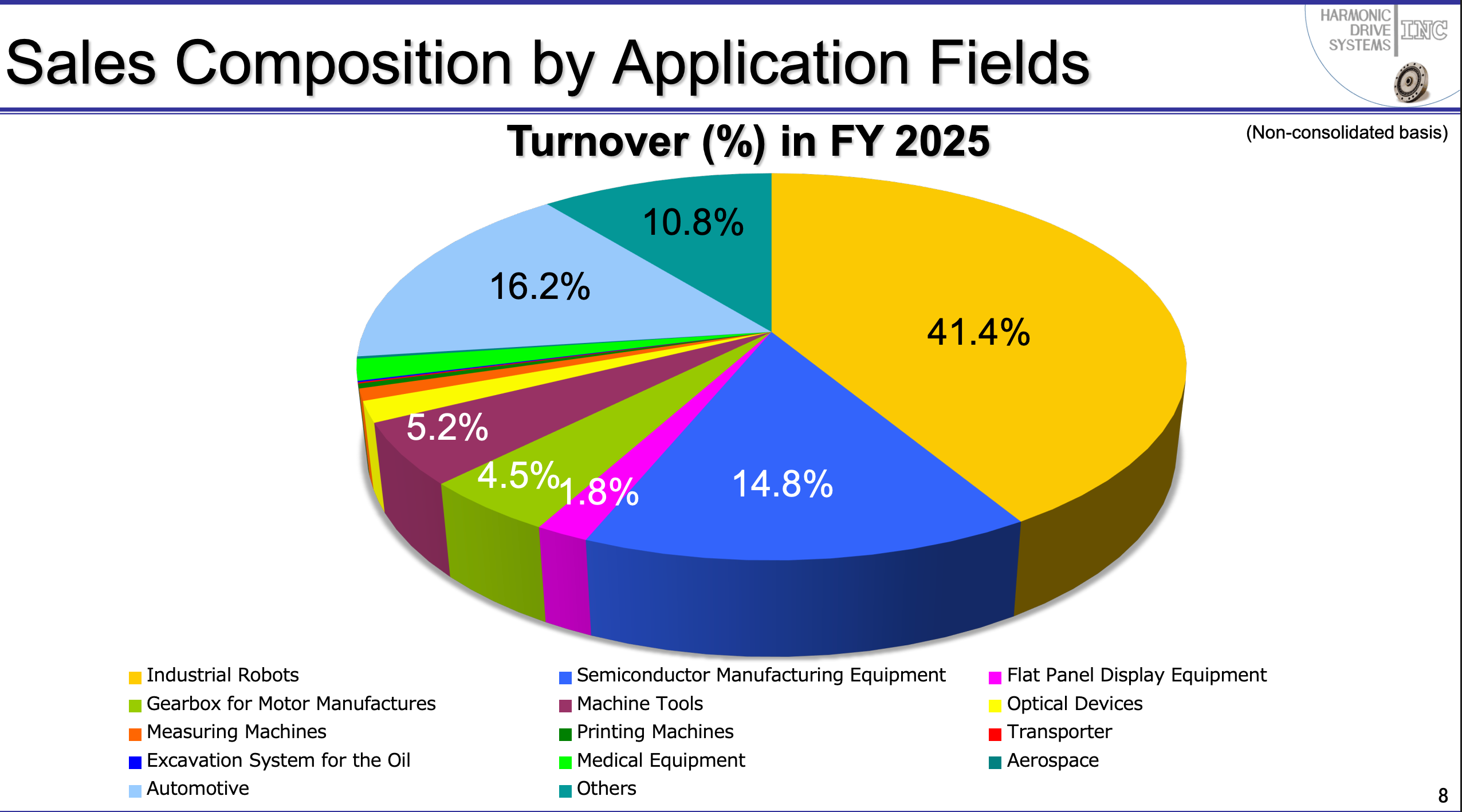
Industrial Robots (41.4%): This is the massive yellow slice of the pie and the undisputed bread and butter of the company. Harmonic Drive has spent decades positioning itself as the “hidden king” of traditional factory automation. When giants like FANUC, KUKA, or Yaskawa build multi-axis robotic arms for automotive assembly lines, they buy Harmonic Drive’s precision strain wave gears to eliminate backlash and ensure micrometer accuracy.
Automotive (16.2%): The second largest segment (light blue) consists of high-volume component supply for the traditional auto industry, including long-term steering and engine contracts with legacy players like Nissan.
Semiconductor Manufacturing Equipment (14.8%): A crucial high-margin segment (dark blue). Inside pristine semiconductor fabs (think TSMC or Intel), vacuum robots have to precisely move fragile silicon wafers without a single vibration. Those cleanroom robots run on Harmonic Drive components.
Aerospace & Defense (10.8%): A highly regulated, sticky segment (dark green) that builds specialized gears for aviation (Airbus) and low Earth orbit satellite communication systems.
From Gears to Actuators
Look at that FY 2025 chart again. You’ll notice one striking detail: AI and humanoid robots don’t even have their own line item. Today, the humanoid market is practically invisible on the balance sheet, buried deep within “Industrial Robots” or “Others” as tiny prototype batches.
But this chart represents the old world of Harmonic Drive, a world of pure mechanical components where competition from cheap Chinese lookalikes is gradually heating up and threatening margins.
To protect its moat, the company is staging a massive technological pivot. Instead of selling “naked” reduction gears (the raw iron wheels), Harmonic Drive is aggressively moving up the value chain to sell integrated actuators.
Think of a reduction gear as a single bone or a ligament. An actuator is a fully assembled, living human joint. Inside one compact metal cylinder, the Japanese engineers pack four complex systems: their proprietary wave gear, a high-performance electric motor, position sensors (encoders), and a built-in microcomputer (driver) to manage power on the spot.
For an AI robotics startup, this is a game-changer. Instead of spending two years and millions of dollars trying to figure out how to cleanly mount a motor to a gear and wire up sensors without overheating, they simply buy a ready-made “elbow” or “knee” from Harmonic Drive. They bolt it to a carbon fiber frame, plug in a data cable from their main AI brain, and the joint is instantly ready to execute complex movements.
By shifting from component manufacturing to high-torque integrated actuators, Harmonic Drive is solving two critical strategic issues at once: it prices out low-end competition who can’t replicate the complex electronics packaging, and it exponentially increases the dollar-content per robot sold.