

The primary beneficiaries will be European defense companies, whose market cap remain much smaller than those of Europe’s largest firms. For example, the most valuable company, LVMH, has a market cap of €300B, while Novo Nordisk stands at €268B. These giants dwarf the continent’s leading defense firms. Rheinmetall, which has surged 800% in the past three years, still has a market cap of just €60B.
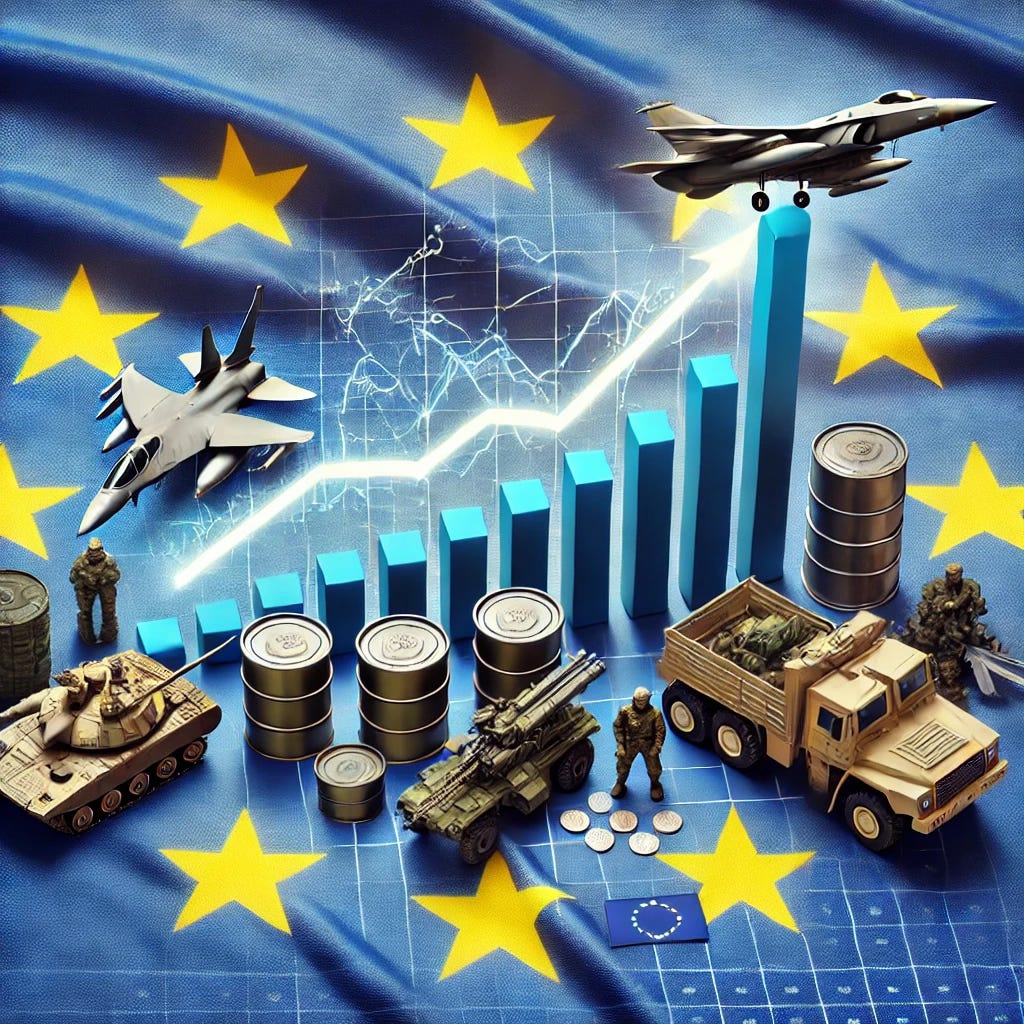
Other key players include ThyssenKrupp AG, with a market cap of €5B, BAE Systems with a market cap of €49B, Thales at €51B, and Leonardo at €27B. Airbus, at €136B, remains the largest defense company in Europe, but even if we combine the market caps of these firms, their total valuation remains far below LVMH’s. One company seeing growing demand is MBDA, a European missile manufacturer co-owned by BAE Systems, Airbus, and Leonardo. The company has been fielding increasing inquiries from European militaries looking to diversify away from U.S.-made weapons. CEO Eric Béranger has noted that some nations traditionally reliant on American capabilities are now turning to MBDA for alternatives.
Militarisation of Europe: Who Gains the Most?
First, Europe is moving toward militarization. Countries with major defense companies will gain more influence, especially if the continent continues reducing reliance on the United States. Germany is expected to order six ThyssenKrupp Marine Systems battleships valued at more than €15B ($16.4B) and 20 additional Eurofighter jets from BAE and its partners, worth approximately €3 billion. These funds, which previously went to American firms, will now stay within Europe. While former Chancellor Olaf Scholz allocated significant budgets for U.S. companies such as Lockheed Martin (F-35 fighter jets), Boeing (Chinook transport helicopters), and Raytheon (Patriot air-defense systems), the current government is prioritizing local firms.
Second, Europe’s defence spending remains significantly below that of the U.S. The EU currently spends $430Bannually on defense, compared to $755B in the U.S. A substantial increase in spending will strengthen the political leverage of countries with major defense contractors. Even Volkswagen has signaled readiness for military production. A larger domestic defense sector will give the EU greater influence in negotiations with the U.S. while also shifting internal power dynamics within Europe. Increased defense investments will create thousands of jobs, bolstering the ruling German coalition while potentially weakening the far-right AfD. This shift is crucial for the stability of the EU but raises broader questions.
A New European Divide?
Countries with strong defense industries will demand greater contributions from other member states, many of which cannot afford to borrow as much as Germany. This could deepen existing fractures within the EU. As new alliances emerge and some nations seek to distance themselves, the prospect of further political fragmentation becomes a real possibility. However, if properly managed, Europe’s growing defence capabilities could serve as a unifying force—if political leaders can summon the will to coordinate their efforts effectively.
Building strategic autonomy in key sectors is now a recognised urgent imperative across Europe, according to a letter from Airbus, Dassault Systemes, and over 90 other European firms and lobby groups. “Europe needs to recover the initiative and become more technologically independent across all layers of its critical digital infrastructure: from logical infrastructure—applications, platforms, media, AI frameworks, and models—to physical infrastructure—chips, computing, storage, and connectivity,” the letter stated.
But this raises the final, uncomfortable question: Is Europe truly ready for militarization? Spending billions is one thing, but military capability isn’t just about budgets—it’s about strategy, cohesion, and political will. If Germany and the EU fail to integrate these forces into a coherent framework, this surge in defense spending may create more fragmentation, not unity. Europe’s military rise could either strengthen its geopolitical position or expose deep structural weaknesses. If the latter happens, today’s investment boom could become tomorrow’s biggest liability.
The market hasn’t fully priced in this shift yet. Defense stocks in the U.S. boomed after Washington ramped up spending. Will EU stocks follow? If this trend holds, the biggest winners are still undervalued.
This publication is for educational and informational purposes only and does not constitute financial, investment, or trading advice. Readers are solely responsible for their own investment decisions. The author may hold positions in the securities mentioned.