


Goldman Sachs recently upgraded its global humanoid robot market forecast to $138 billion by 2035, projecting cumulative shipments to hit roughly 6.5 million units. Today, the entire global footprint sits at just 75,000 machines.
Let’s skip the illusions and be completely blunt: these companies are not making money. Every dollar of incoming revenue gets incinerated by R&D, and the entire sector remains in its infancy. Valuations running into the tens of billions are simply a byproduct of an absurd amount of speculative capital sloshing around Silicon Valley and China. Yet the players deploying hardware into the wild right now hold a massive edge over those merely tinkering with lab prototypes.
Case in point: Hyundai just shelved the Boston Dynamics IPO. While management offered no explicit post-mortem, the reality is obvious, there are simply no financial results to brag about. Teaching a bipedal machine to play soccer for a viral video is one thing; generating commercial return on an assembly line is an entirely different beast.
Here is our breakdown of the 10 companies dictating the terms in humanoid robotics, cutting past the PR circus to focus on hard financial realities.
1. Figure AI
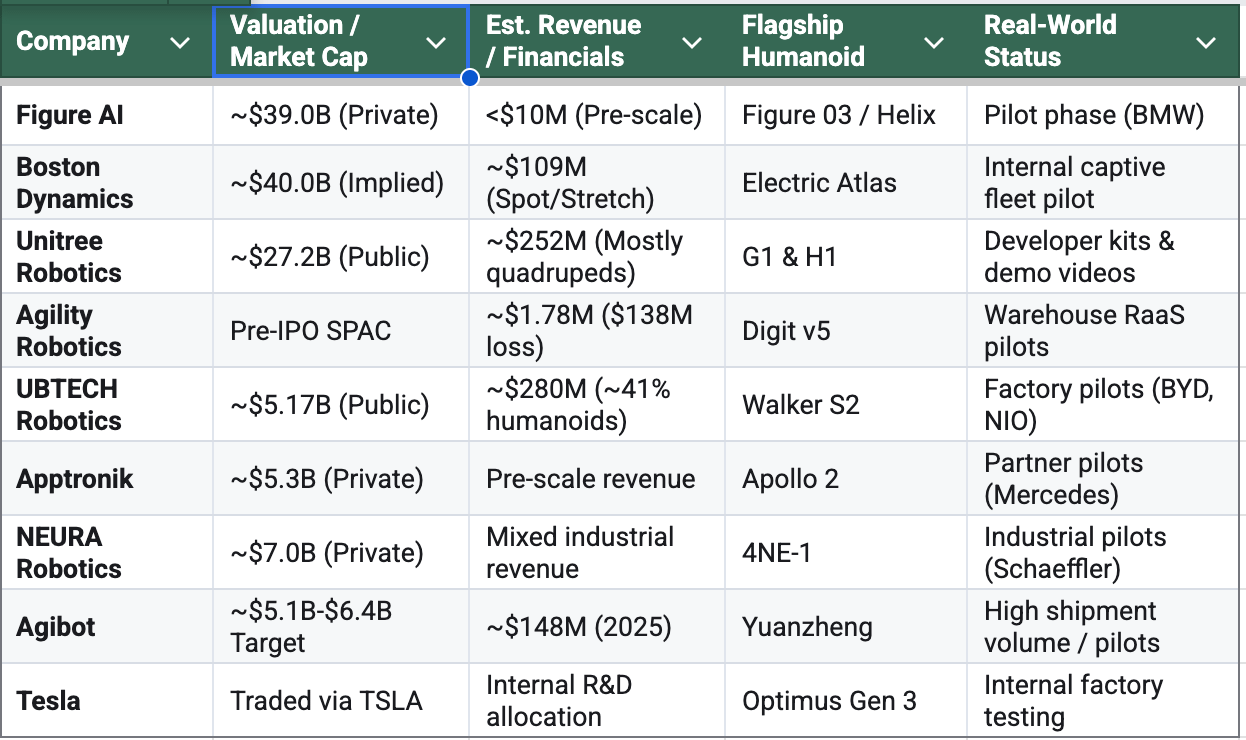
Figure AIFounded in California in May 2022 by Brett Adcock, Figure AI has become the most valuable private player in Embodied AI. Following a $1.0 billion Series C round in September 2025, total funding crossed $1.8 billion, pegging the company’s valuation at a staggering $39.0 to $39.5 billion.
Its hardware roadmap, the Figure 02 and newly unveiled Figure 03, is targeted at generic manufacturing tasks, component assembly, and intralogistics. The platform runs on Helix, a proprietary Vision-Language-Action (VLA) architecture. Figure is executing a pilot contract with BMW at its Spartanburg facility in South Carolina. Yet the top line reflects an early reality: actual revenue remains sub-$10 million annually, derived almost exclusively from pilot evaluations rather than commercial scale.
Management is betting heavily on its upcoming “BotQ” manufacturing site, targeting volume deployment in 2026–2027 under a Robotics-as-a-Service (RaaS) framework tied to warehouse wage parity. Crucially, Figure’s massive $3.5B compute bet on NVIDIA clusters reveals its true architectural thesis. Figure rejects traditional modular robotics. Instead of running heavy mathematical solvers on the machine in real time, it trains end-to-end neural policies in massive physics simulations and imitation pipelines.
The upfront training CapEx is monstrous, effectively pricing smaller startups out of the race, even though the onboard inference on the physical robot is fast and power-efficient. This highlights the central architectural divide in robotics today: pure end-to-end neural policies (Figure, Tesla) versus hybrid architectures like Boston Dynamics, which pair high-level AI vision with deterministic, classical control theory to guarantee balance.
2. Boston Dynamics
Figure is betting billions that data and compute will render classical engineering obsolete. Even so, Boston Dynamics could have commanded a comparable $40B valuation at IPO, though South Korean broker targets diverged by as much as 100%. Valuing an initial fleet of 30,000 Atlas units remains elusive, primarily because they are slated to serve as captive labor for their parent company. If Hyundai executes this internal deployment, it will mark the single most disruptive milestone in humanoid robotics, triggering an aggressive re-rating of Hyundai Motor Group itself.
Hyundai has already funneled roughly $2.5 billion into the venture. By comparison, Boston Dynamics generated around $109 million in 2025 revenue, derived almost entirely from deliveries of its quadruped Spot and warehouse Stretch systems rather than humanoids.
The new electric Atlas is built directly for the assembly line, capable of handling sustained loads of up to 30 kg (with an instantaneous peak of 50 kg). Crucially, Boston Dynamics is also training Atlas inside NVIDIA physics simulations via Large Behavior Models (LBMs) developed with the Toyota Research Institute (TRI). This diffusion-driven architecture allows Atlas to perceive and react to dynamic obstacles in real time, executing unprogrammed manipulation tasks on the fly while retaining its proven, deterministic dynamic balance.
Tesla and Figure are betting that with enough data, neural nets will just figure out physics on the fly. Boston Dynamics isn’t buying it.
With a hybrid stack, Atlas treats high-level AI as a cognitive suggestion, while deterministic physics keeps veto power. If the neural net hallucinates a trajectory, the control loop kills the movement before an 80-kilo pile of metal crushes an engine block or snaps an operator’s arm.
This is where Dario Amodei’s endless hand-wringing about AI safety actually becomes relevant, except here, it’s not about hypothetical rogue code, but raw mechanical kinetic force. On a live assembly line, you get zero margin for error. A single catastrophic malfunction won’t just trigger multi-million-dollar OSHA fines and wrongful death lawsuits; it will shut down the entire plant. That legal and physical liability is the real reason these deployments are moving at a snail’s pace while companies quietly torch billions just running endless lab tests.
3. Unitree Robotics
Unitree has already shed half its market cap since its IPO, settling at around $27 billion. That still leaves a P/S multiple near 100 on $252 million in revenue, with $41 million in net profit. The catch is that humanoids generated almost none of it.
Virtually all of that cash flow comes from quadruped robotic dogs (the Go2 and B2 series) deployed for perimeter security, industrial inspections, and university labs. Meanwhile, the company’s humanoids, the flagship H1 and the sub-$16,000 G1, serve primarily as viral marketing assets. They run on NVIDIA’s robotics stack, relying on onboard Jetson Orin modules for edge processing and Isaac Gym for simulation training. They dance, sprint at a record 3.3 m/s, do backflips on camera, and sell in limited batches to researchers.
Beyond choreographed demo clips, there is zero public evidence of these machines operating on live factory floors, zero disclosure on enterprise contracts, and no track record of sustained task completion in industrial workflows. Until Unitree demonstrates consistent uptime in unscripted, high-stress environments without human engineers hovering over emergency kill switches, its humanoid division remains a high-profile hardware demo rather than a commercial business.
Exports accounted for 43.65% of revenue, confirming genuine global appetite for the hardware. Unitree is targeting 10,000 to 20,000 humanoid units for 2026. Yet shipping commoditized hardware kits to developers is worlds apart from replacing industrial labor. Unitree can build cheap machines at scale; the unresolved question is whether they can generate economic value once the filming stops.
4. Agility Robotics
Venture pitch decks love clean unit economics: buy a Digit for $200k, pay $20k for deployment plus $36k annually for software, run it across two daily warehouse shifts, and claim an effective labor rate of $14/hour against a $30+ human worker. On paper, the machine pays for itself in 13 months.
Then you open Agility’s actual SEC filings, and the spreadsheet fantasy evaporates.
In its S-4 registration statement tied to the Churchill Capital Corp XI SPAC merger, Agility disclosed just $1.78 million in 2025 revenue against a crushing $138.1 million net loss. Worse still, roughly 64% of that revenue came from related-party transactions rather than arms-length commercial sales.
Agility boasts an order backlog north of $300 million, but the bulk of it rests on a single RaaS agreement for 1,000 units and that customer is a related party. Manufacturing paper demand through related parties is an old, well-worn playbook for cash-burning microcaps and pre-revenue startups. Most of these headline-grabbing commitments are soft agreements, pilot trials, or non-binding memorandums of understanding (MOUs) designed to inflate valuations ahead of a public listing. Until a customer signs an irrevocable purchase order and that cash hits an audited income statement as recognized revenue, an order backlog is little more than investor marketing collateral.
The unit economics don’t hold up on the warehouse floor, either. The pitch-deck model assumes a five-year hardware lifespan, but running two shifts a day puts roughly 5,000 operating hours on the joints annually. In all likelihood, Digit won’t survive five years of relentless operational friction; mechanical reality suggests actuators degrade, harmonic gearboxes lose precision, and lithium cells decay long before that payback window closes. Even with high uptime, you still need dedicated on-site engineers on payroll just to babysit edge cases and mechanical faults.
Under the RaaS structure, the manufacturer acts as an unsecured equipment lessor, shouldering all the upfront capital expenditure, depreciation, and hardware risk while customers merely lease the hours. In audited accounting, it currently costs Agility nearly $80 to generate a single dollar of top-line revenue.
The unveiling of Digit 5 perfectly illustrates the sector's reliance on narrative momentum over industrial reality. Facing a pending public listing via SPAC and burdened by filings showing nearly eighty dollars burned for every single dollar of recognized revenue, Agility timed the release to promote a cage-free safety architecture. Yet swapping battery packs and tweaking bird-legged kinematics does nothing to resolve the core unit economics.
title=”Agility Robotics Broadens Relationship with Amazon” frameborder=”0” allow=”accelerometer; autoplay; clipboard-write; encrypted-media; gyroscope; picture-in-picture; web-share” referrerpolicy=”strict-origin-when-cross-origin” allowfullscreen></iframe>
5. UBTECH Robotics
UBTECH is a classic market anomaly. Generating the exact same top-line revenue as Unitree, it trades at one-fifth the market valuation, with its stock price plummeting by 50% year-to-date. In robotics, hype drives multiples far more than audited financial performance.
UBTECH is not immune to running its own hype machine. This week, the company closes pre-orders for its line of domestic companion humanoids—machines designed to sit on a sofa, listen, and talk back. The flagship aesthetic model commands an absurd $140,000 price tag. Who genuinely needs a six-figure conversation box in their living room remains a mystery, yet UBTECH managed to rack up 13,000 pre-orders.
The industrial Walker series follows an uncomfortably similar script. Behind the headline delivery figures, there is little groundbreaking proprietary value in the hardware itself.
On factory floors, Walker S humanoids operate inside pilot zones across automakers like NIO, Dongfeng Motor, FAW-Volkswagen, Geely, and BYD, but their actual workload is strictly confined to basic, risk-free assignments. The robot handles visual quality inspection, pacing along vehicles to verify panel alignment, door seal fit, and badge placement. Because this requires zero physical contact with the car body, there is zero risk of scratching paint or denting sheet metal.
Beyond contactless inspection, manipulation tasks remain trivial. Walker S performs lightweight component sorting, picking fuses and relays to seat them into power distribution blocks, or moving small plastic trim pieces from trays to workstations. For mechanical fastening, trials at Dongfeng involved the robot grabbing a tethered, suspended electric screwdriver to torque pre-aligned fasteners into door trim along fixed, hard-coded coordinates.
None of this reflects organic market demand. Nearly all automakers testing Walker S are either state-owned enterprises like Dongfeng and FAW, or domestic EV manufacturers heavily backed by government programs. These deployments are largely subsidized by Beijing’s national robotics initiatives, where automakers receive dedicated state funding specifically to host joint automation pilots.
The core constraint remains mechanical speed. On active automotive assembly tasks, Walker S takes 2.5 to 3 times longer to complete an operation than a human line worker. In an industry governed by strict 60-to-90-second takt times, that speed deficit locks humanoids entirely out of primary assembly lines. Automotive plants keep them tucked away in auxiliary pre-assembly cells or subsidized joint R&D bays, far from the critical path of production.
6. Apptronik
Apptronik is tracking the exact same trajectory as its peers. The company picked Mercedes-Benz as its showcase pilot partner, who also happens to be an equity backer alongside Google. On the company’s homepage, Apollo smoothly packs items into containers, but the underlying commercial unit economics are nonexistent. Apptronik discloses zero revenue metrics, confirming that multi-million-dollar enterprise purchase orders simply do not exist yet.
None of this is surprising. Clearing heavy, un-caged kinetic machinery to share an open floor with human assembly workers requires rigorous OSHA and ISO safety certifications that take years, not months. There is a reason Boston Dynamics’ public listing keeps getting deferred—taking a pure cash-burning humanoid lab to public markets right now is impossible.
The focus on automotive plants across Mercedes, John Deere, and GXO is deliberate. Automakers represent the ideal target because assembly lines rely on fixed, repeatable cycles and are already the most heavily automated industrial environments on earth. At the same time, human pushback is escalating; union labor has already threatened industrial action over the threat of automated bipedal labor.
That same assembly line is also where the humanoid thesis breaks down. In modern vehicle manufacturing, a halted conveyor costs tens of thousands of dollars per minute. A single hesitation, an unhandled edge case, or a dropped sub-assembly halts the entire line, erasing any theoretical labor cost savings in seconds. For these machines to generate an actual return on investment, they must deliver flawless uptime, operate at human line speed, take natural instructions from floor workers, and guarantee zero cosmetic damage to painted chassis. Right now, running a multi-billion-dollar valuation on non-paying pilots isn’t an industrial reality—it is a speculative bet on narrative over factory floor physics.
Apptronik has raised $935 million to date, an amount that exposes a glaring strategic contradiction. If the goal is simply deploying a machine to shuffle pallets and tote boxes, nearly a billion dollars is excessive, bordering on capital misallocation. Yet the margins on basic warehouse material handling are razor-thin, leaving no room for venture-scale enterprise returns.
Conversely, competing directly with Figure AI to build a true General Purpose Humanoid demands billions more. Developing an adaptable, end-to-end foundation model requires purchasing dedicated semiconductor clusters, rendering millions of synthetic simulation environments, and training full-scale digital twins through massive neural networks.
A $935 million balance sheet leaves Apptronik stranded in a capital valley of death. The budget is too small to build a world-class proprietary compute cluster, forcing the company into the role of a permanent tenant reliant on Google DeepMind models and NVIDIA’s off-the-shelf robotics stack. Caught in the middle, Apptronik’s hardware remains economically uncompetitive for simple warehouse chores, while its capitalization falls critically short of funding true physical artificial intelligence.
7. Neura Robotics
Neura built a legitimate business selling cognitive robotic arms and logistics units to industrial heavyweights like Kawasaki and Omron. That real factory footprint gave the company the credibility to raise massive capital and position itself as a European hardware champion.
Strip away the arms and industrial sensors to isolate the humanoid division, however, and Neura runs the exact same marketing playbook as its peers.
The company lists its 4NE-1 biped with public volume pricing: €98,000 for up to 20 units, dropping to €60,000 for larger batches. The catch is the reservation barrier. Securing a spot in line requires a refundable €100 deposit. Anyone with pocket change can place an order and claim they have a humanoid on the way. It is a retail lead-generation funnel designed to manufacture an unverified order backlog for fundraising slide decks.

Actual factory deployments tell a different story. Hard commercial purchase orders with upfront hardware commitments are nonexistent. The single landmark deal Neura points to is a headline-grabbing framework agreement with German supplier Schaeffler, valued at roughly €300 million.
The detail that matters is duration. The deal stretches across a ten-year timeline through 2035, averaging just €30 million a year. For a conglomerate like Schaeffler, that is an inexpensive corporate hedge, not an immediate assembly line overhaul. The agreement is non-binding, back-loaded, and contingent on technological milestones that bipedal hardware has yet to solve commercially.
Much like its peers, Neura leverages loose, decade-long corporate memorandums and consumer reservation deposits to mask the lack of near-term cash generation. A €100 deposit is cheap marketing, and a ten-year industrial MOU is corporate signaling. Neither represents a validated commercial humanoid business
8.AgiBot (Zhiyuan Robotics)
Founded in early 2023 by former Huawei engineer and video blogger Peng Zhihui, AgiBot is executing the most aggressive volume-dumping strategy in the global robotics sector. The company pulled in backing from Sequoia China, Hillhouse, and automotive giant BYD, positioning its upcoming Hong Kong initial public offering at an ambitious $5.1 billion to $6.4 billion valuation.
The headline metrics appear staggering on the surface. Full-year 2025 revenue reached $148 million, followed by an explosive first quarter in 2026 where the company matched its entire previous annual output in just 90 days. Global market trackers reported that AgiBot captured over 43% of worldwide humanoid volume in the first half of 2026 by shipping an astounding 9,700 units, blowing past Unitree to claim the global crown.
The volume narrative collapses once you look at who is writing the checks. Those 10,000 units are not replacing factory workers on industrial assembly lines.
Over 60% of deliveries are split between two non-industrial markets. The primary buyers are government-funded AI research labs, universities, and software houses purchasing hardware platforms simply to harvest teleoperated physical data for model training. The secondary buyers are corporate event spaces, shopping malls, and tech showrooms using wheeled, interactive chassis for customer greeting and scripted entertainment.
AgiBot achieves these delivery numbers by mixing distinct form factors. Alongside full-sized bipedal machines like the Yuanzheng line, their shipment tallies include wheeled dual-arm units, half-scale desktop rigs, and modular research chassis. Distributing subsidized research kits to academic labs and promotional robots to commercial venues is a brilliant top-line growth hack, but it does not represent enterprise manufacturing labor.
To engineer recurring revenue ahead of its public listing, AgiBot is pushing BotShare, a robot rental platform designed to convert low-utilization hardware into subscription metrics. Instead of selling an outright industrial solution, the company rents hardware to event organizers and temporary venues, booking immediate utilization to pad annual recurring revenue metrics for investment bankers.
AgiBot leverages the hyper-efficient Chinese component supply chain better than anyone, pumping out hardware shells at speeds Western labs cannot match. When the Hong Kong listing prospectuses open up, audited financials will expose the structural reality: the company is currently a high-throughput distribution funnel for state-subsidized developer hardware, not an operating replacement for human factory labor.
Tesla (Optimus)
Tesla plays in an entirely different financial and computational universe. Unlike venture-backed startups scraping together funding for single-cluster compute runs, Optimus leverages Tesla’s massive in-house capital base, custom Dojo and NVIDIA GPU clusters, proprietary inference chips, and the real-world computer vision engine refined across billions of miles of Full Self-Driving data. The bull thesis sells Optimus as the ultimate enterprise endgame: tens of millions of mass-produced bipedal machines priced under $30,000, destined to completely dwarf the commercial valuation of Tesla’s core automotive operations.
The reality inside Tesla’s own manufacturing facilities tells a much narrower story. Despite aggressive shareholder guidance targeting thousands of autonomous units running factory shifts, real-world deployment remains an exploratory data-gathering operation. The units operating within Fremont and Giga Texas are not working on high-speed final vehicle assembly lines.
They perform basic battery cell sorting, shift parts between stationary kitting stations, and walk navigation loops while full-time human operators monitor their every move. Regulatory disclosures confirm that initial unit batches were diverted to internal training academies, functioning as teleoperated sensory rigs designed to log physical interactions rather than perform commercially viable labor.
Tesla possesses the capital depth, vertical actuator design, and end-to-end compute scale required to crack general-purpose robotics if the physical engineering problem is solvable. For public equity markets, however, Optimus primarily functions as an indispensable valuation bridge: an unpriced call option on limitless, zero-marginal-cost labor that management deploys to justify high-growth software multiples whenever automotive gross margins face price-war pressure. Until an untethered Optimus can match an unforgiving 60-second takt time on a live Model Y production line without human supervisors ready to hit an emergency stop, it remains an expensive, narrative-driven internal R&D hedge on an automotive balance sheet.
Scaling is far off
Commercially viable humanoid robotics deployments simply do not exist today. Nowhere on earth are bipedal machines running at industrial scale; every active deployment is either a tightly chaperoned pilot near a conveyor belt or a data-harvesting exercise inside an academic lab. This friction is entirely normal. Before a kinetic humanoid is permitted to share a work cell with human labor, it has to prove not just mechanical efficiency, but total physical safety.
The romantic honeymoon phase of humanoid investing is officially over. Public equities reflect that exhaustion clearly: Hyundai’s market valuation has shed 50% from its peak just months ago. The conversation has decisively pivoted from viral hardware demonstrations to who can execute commercial reality first.
Automotive incumbents hold an unmistakable home-field advantage here. Tesla and Hyundai can design, constrain, and validate humanoid systems engineered strictly around internal assembly line operations.
That captive factory floor does not guarantee them the crown. Pure-play robotics firms are racing toward a fundamentally different objective: building proprietary, general-purpose platforms capable of dropping into any industrial facility or ambient environment with zero custom reprogramming.
The determining factor is capital cost. The $3.5 billion Figure AI committed to its NVIDIA compute cluster now stands as the baseline industry benchmark for developing real-world physical intelligence.
For now, the operational playbook for investors remains straightforward: ignore the demo reels and look strictly at executed enterprise purchase orders and unit economics. Everything else is narrative packaging and subsidized science projects. The balance sheet tells the only story that matters.
This publication is for educational and informational purposes only and does not constitute financial, investment, or trading advice. Readers are solely responsible for their own investment decisions. The author is long Hyundai