


Semiconductors sit at the physical foundation of the AI economy. Every model, every GPU cluster and every hyperscale data center ultimately depends on an extremely complex industrial stack that begins long before a chip ever reaches NVIDIA or Microsoft.
At the center of this stack sits Applied Materials ($AMAT).
Applied does not design chips. It does not run foundries. And it does not sell GPUs.
Instead, it builds the machines that make modern semiconductors physically possible.
Every advanced chip requires hundreds of process steps. Thin films must be deposited atom by atom. Materials must be etched with angstrom-level precision. Structures only a few nanometers wide must be inspected, repaired and optimized before the wafer ever leaves the fab.
That entire process is driven by semiconductor equipment.
This is where Applied Materials operates.
The company is one of the largest process equipment suppliers in the world, alongside ASML and Lam Research. But while ASML dominates lithography, Applied sits at the center of materials engineering, which has quietly become one of the most critical bottlenecks in modern chip manufacturing.
As transistor architectures become more complex and packaging technologies evolve, the number of materials steps continues to grow. New transistor designs like gate-all-around, advanced DRAM structures used in HBM, and increasingly complex chiplet packaging all require new deposition, etch and materials engineering solutions.
That means the economics of AI are not driven only by chip designers.

They are increasingly driven by the companies that enable chips to exist in the first place.
In this deep dive we will break down:
• how the semiconductor manufacturing stack actually works
• why Applied Materials sits in a structurally advantaged position inside that stack
• how AI data center demand is reshaping wafer production and memory architectures
• and why the industry could reach $1 trillion in semiconductor revenue years earlier than expected
Supply Chain
To understand the AI boom, it is not enough to look at GPUs.
You have to understand the machines that build the chips.
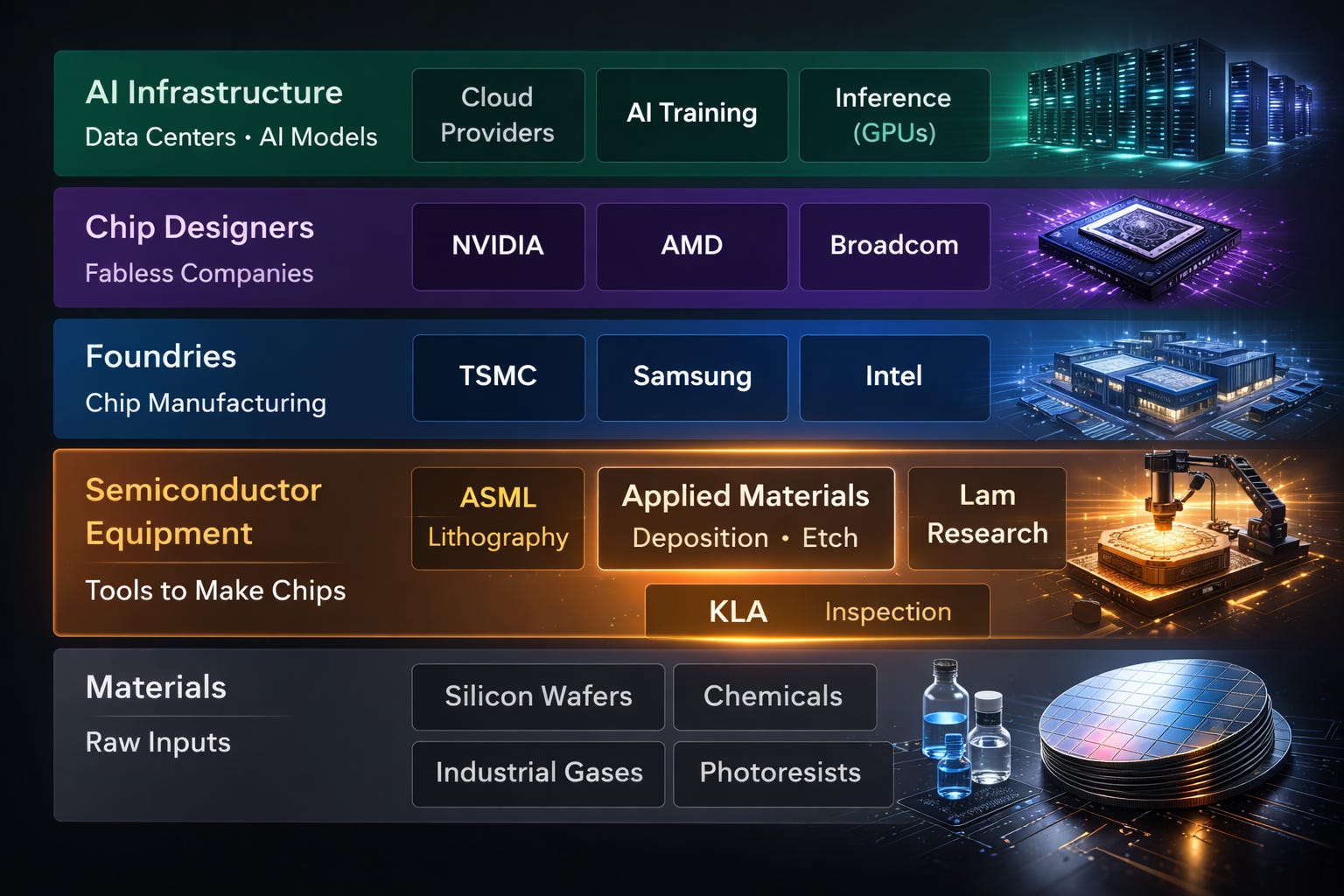
The semiconductor industry is often described as a complex ecosystem, but the basic structure is actually straightforward.
Everything begins with raw materials. Ultra-pure silicon is processed into silicon wafers. These are the circular substrates on which chips are built. Along with wafers, the process requires specialty chemicals, industrial gases and photoresists.
Those wafers then move into the semiconductor fabrication stage, where chips are physically manufactured. This is where foundries like TSMC, Samsung and Intel operate massive fabrication plants.
But these factories cannot function without extremely specialized tools.
That is where companies like Applied Materials, ASML and Lam Research enter the picture.
These firms produce the equipment that actually builds the chip layer by layer on the wafer.
• ASML provides lithography systems that project chip patterns onto the wafer using extreme ultraviolet light.
• Lam Research provides etching tools that carve microscopic structures into the silicon.
• Applied Materials provides deposition and materials engineering tools that add the thin films and structures that ultimately form transistors and interconnects.
In other words, before a single NVIDIA or AMD chip exists, an enormous amount of capital equipment must first build the structure of that chip atom by atom.
Once the wafers are processed, they move to advanced packaging and testing, where individual chips are cut out of the wafer and assembled into final products.
Only then companies like NVIDIA, AMD or Broadcom integrate them into GPUs, accelerators and networking chips that power AI infrastructure.
From an investor perspective, companies like Applied Materials sit in a critical position in this chain.